Sunday, August 18, 2013

The Mystery of Apache Chief

Today, I'm reaching out to readers of this blog concerning a question about one of the four non-DC superheroes Hanna Barbera created for the The All New Super Friends Hour in in 1977.

I am of course talking about Black Vulcan, Apache Chief, Samurai and El Dorado (pictured below with Rima who was actually a DC character and the Wonder Twins)


Here's my theory - I think HB want to to give the show a more multicultural feel and here's how I think it went down. HB asked DC if they had any superheroes who weren't white Anglo Saxons, whereupon DC replied with Black Lightning, Red Tornado, Martian Manhunter and someone else. 
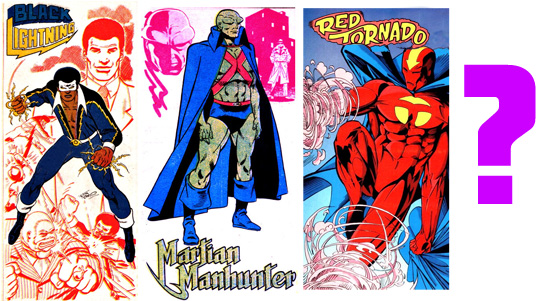
 

And while those characters are indeed non-white guys, Hanna Barbera wasn't satisfied with that selection, so someone inhouse was given the task of creating new superheroes for the show. The best candidates were creative producers Ken Spears and Joe Ruby though Jeffrey Scott, writer of the show at the time was unable to confirm this as of 2011. We do know Alex Toth designed the look and feel of the characters.


The Black Lightning/Black Vulcan connection is a pretty much a given as we DO know that Black Lightning was in the original discussion, but was tabled due to a dispute between DC and Black Lightning creator Tony Isabella.

My theory that Martian Manhunter and Red Tornado were the inspirations for Samurai and El Dorado is pretty much based on the similarities in powers.

Samurai was a human tornado like Red Tornado.


El Dorado (whose powers were ambiguous and never really defined in the show) was shown several times using powers shared by the Martian Manhunter (superhuman strength, telepathy.) And where the Martian Manhunter uses phasing, El Dorado similarily uses teleportation.


Even El Dorado's costume, with its open torso design is similar to Martian Manhunter's costume.


My question today is: Who was the inspiration for Apache Chief?


There were a couple of Native American Superheroes in the DC Universe at the time who could be likely candidates...

Super Chief


and Scalphunter


Though neither of them have powers similar to Apache Chief (not necessarily evidence that they weren't the inspirations, but it does seem like a break in the MO.)

My best guess is that AC was some sort of amalgamation of both characters. His name uses the Chief title but his costume design is closer to Scalphunter's.

Oddly, the back and forth on more multicultural heroes may have paved the way for another Native American character in the DC Universe: Dawnstar. 


Her first appearance was in April 1977. Given that the prior year, talk of Hanna Barbera wanting more multicultural heroes may have been buzzing around the office, it is possible that Paul Levitz and Mike Grell were encouraged (either creatively or editorially) to create a new Native American character.

I also find it interesting that her yellow and white character design so closely resembles the original proposed yellow and white Apache Chief color scheme.
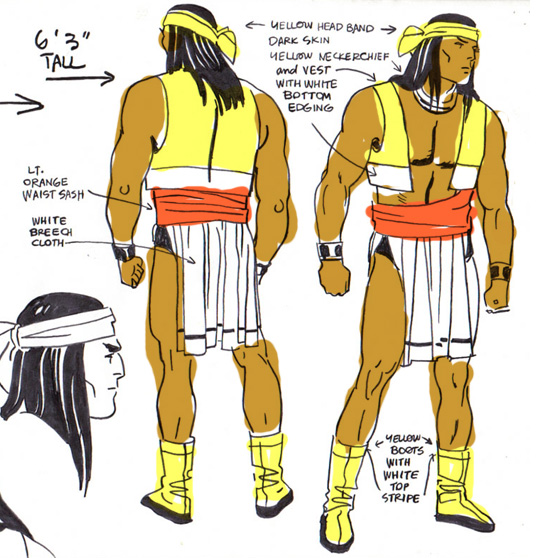


If anyone out there has anymore details about the origins of these characters, I would love to hear from you.

- Jim

Sunday, August 11, 2013

Fake Geek Girls, Heavy Metal Posers and other threats to humanity

Over the past few months, I've watched the turmoil that has arisen from people pushing the term Fake Geek Girl. For those of you new to the term this article from Forbes.com by Tara Tiger Brown sums up the concept:


Pretentious females who have labeled themselves as a “geek girl” figured out that guys will pay a lot of attention to them if they proclaim they are reading comics or playing video games. Celebrities are dressing up as geeks to reach a larger audience. Richard Branson labeled himself a geek for crying out loud.

~Tara Tiger Brown, Dear Fake Geek Girls: Please Go Away
3/26/2012

Here is the catchy counter arguement in video format: 

Nothing to Prove - Geek Girls & The Doubleclicks

My take is this: I'm inclined to think that people who fear the supposed onslaught of Fake Geek Girl hordes are at best worried about the devaluation of whatever Geek Cred they have and at worst misogynists.

I've seen both Fan Boys and Comic Professionals make statements that suggest they think Fake Geek Girls are detrimental to their hobby in some way. I think its telling that the same people who are so down on Fake Geek Girls don't seem to have a problem with Booth Babes. Next time a thread about a con wanting to ban Booth Babes pops up, watch how many people will cry in outrage. That to me reveals their personal agenda: Girls in outfits are okay if they are there to entertain me - not get in front of me in the queue for the next Firefly panel.

I used to see this same sort of back and forth in my Heavy Metal days. Back in the 80's, it was common for some people to call metal fans of a certain ilk Posers. However, the definition of Poser was a very slippery thing. Whenever I would press other metal heads or punk rockers for a clear definition, they would start with how someone might dress a certain way but not truly be into the scene. (Which sounds a lot like the FGG issue, doesn't it?)

In the early 80's the classic image people would give me was guys who weren't in a band, but would dress up like Judas Priest and just show up at rock clubs to look cool.


As the years went by, the definition of Poser changed such that it was now guys who looked like Poison or Guns and Roses but might actually be in a band.
 
The defining difference being that the Poser band was seen as jumping on a musical bandwagon  and weren't playing "Real Metal."


So, what's struggling band supposed to do? Well, try to play Real Metal of course. The only thing is - no one could agree what that meant.

Was it Thrash/Power Metal like Metallica?

Nope. Not if you were a Slayer Fan.
And Slayer Fans were called posers by Celtic Frost fans.
And Doom Metal fans thought that Death Metal fans were all posers.
Ect...

The Anti-Poser mindset was like an Onion. As you drilled down through the layers metal of you would always encounter metal-intelligensia who viewed fans who had not heard of the latest undergound band or long lost 60's pioneers in the genre as inferior.

Comedian and unabashed metal-head Brian Posehn made a video about this very idea:

BRIAN POSEHN - More Metal Than You


Currently, I'm seeing a return to this More Metal Than You attitude as fans of the New Wave of Thrash bands like Evile and Warbringer run up against fans of bands like Black Veiled Brides and Avenged Sevenfold. This sort of thing is ultimately unhealthy for the scene as is encourages exclusionary divisions which make people uncomfortable.

I think that's the danger of the whole Fake Geek Girl mindset. I don't really think there is a vast, far reaching conspiracy of Fake Geek Girls vying for the ever so valuable and long lasting attention of fan boys everywhere. It's just an idea that makes some insecure fans feel superior to people they view as a threat in some way.

As far as I'm concerned, no one gets to set the rules on what a real fan is. The guy who can name every single X-men and the guy who only reads black and white independent comics don't get to tell the fan who just started comics with Marvel Now or the Avengers movie that they are a fake geek.

Trying to exclude people from the hobby because they don't meet your standards as a fan is a real jerk move.

- Jim

Sunday, August 4, 2013

Go Team Comics! 80's Style

Editor's Note: I recently saw this blog referred to as being one of those "Go Team Comics" blogs in a way that I thought was not only a bit insulting but also misguided (given my often critical analysis of industry strategies). However, the comment did inspire today's post title, so I guess even detractors can be a source of inspiration. - Jim

Of late, I've been reading (for the first time) the classic Keith Giffen run of L.E.G.I.O.N. I'm up to issue 18 and I've been impressed with how solid the run is for so long.


Most of the series tends to run in the sci-fi lite realm that most comic series tred in, but what makes it interesting is seeing Giffen play with the Legion of Superheroes mythos (the Emerald Eye, Durlans and the Champion of Talok VIII) in a way that he may have not been able to in the regular LoSH series.

This got me to wondering what other team books from the big two during this era started off so well and kept up the quality for such a long time? Here are five I came up with:

1: John Ostander's Suicide Squad


The premise of villains working as covert government operatives is well trod territory now, but at the time this comic came it was a fresh and exciting idea that Ostrander ran with. While the first arc is a bit rough IIRC, Ostrander gets a better handle on the characters as the series continues - especially Bloodshot, Bronze Tiger and Captain Boomerang as the run plays out. In addition to the fun character work, I enjoyed watching the rogues go from one disasterous mission to another, losing members and gaining replacements every couple of issues.

2: Peter Gillis' Strike Force Morituri


Synopsis: In a future where Earth is at war with a vicious alien race, drastic measures are taken in the form of the Morituri process. Volunteers agree to be endowed with superhuman abilities to fight the aliens with the understanding that the powers will cause early death.

Like Suicide Squad, this series benefits from being able to so handily dispatch and gain characters at a moment's notice. This gives the comic a bit of a frenetic pace storywise which modern readers might find disconcerting, but once you get used to it, it's a fun read.

3: Roger Stern's West Coast Avengers


Back before slapping the word Avengers on every other Marvel comic was a bottom line driven corporate mandate, Roger Stern and Bob Hall developed this interesting title featuring Iron Man (and Hank Pym) leading a group of heroes in California. What the series got right was the involved character subplots that ran issue after issue. Where it was a bit off is with some of the villains (Master Pandemonium for example) who were a bit too D-List at times.

Like most of the series on this list, I either dropped off them at the time or never read them during their heyday because of the economic pressures of college. I think I stopped on this series after the first year or so, but recently a commenter on this blog (Cash Gorman?) suggested I read the John Byrne issues, so that's next on my list after L.E.G.I.O.N.

4: John Byrne's Alpha Flight


In discussing this series with FBU friend Trey Causey, we both agree that the first 12 issues of AF is among the best first year examples of a comic series around. In my mind, the first year is so good that I tend to forget that Byrne continued on it as writer until issue 28 and then Bill Mantlo (another great Marvel workhorse at the time) continued the series until it was eventually cancelled with 120.

One of the things that makes this series so good in my mind is the number of interesting plot twist Byrne brought to the table in the first year. Also, at his creative peak, Byrne was a whirlwind of interesting ideas and with characters like Puck, Snowbird and Marrina, you can see Byrne getting to utilize a lot of the concepts he had built up over the years that might not have fit in as well in the X-men or Fantastic Four.

5: Bill Mantlo's Micronauts


Here is another title where the first 12 issues are just amazing. Obviously inspired by the Star Wars zeitgeist of the time, this series manages to rise above other SW imitators with the help of Mantlo's fleshed out alien worlds and Michael Golden's brilliant visuals. The first year of the series is compelling story of the battle of rebel Micronauts against the Vaderesque Baron Karza. After the battle is resolved, the series tends to drift a bit.

It's always been my opinion that Mantlo (who saw the Micronaut toys at a convention and convinced then EIC Jim Shooter to liscense the brand for a series) viewed the series as a possible movie franchise and scripted out the first arc as the basis of a movie, whch might explain why the series lost its way a bit after the first year.


Those are my Five. What would you add?

- Jim

Saturday, July 27, 2013

Man-Bat Lost 100 Pager

Continuing my series of Lost 100 Pager Super Spectaculars, I present this splendid entry featuring DC's winged warrior of the night: Man-Bat!


The main artwork for this cover was created by Adam Moore, whose artwork I have used before for the fantastic Green Lantern and Adam Strange covers. Adam is also known as Laemeur on deviantArt.com. You can see more of his artwork on his website: http://laemeur.com/

As you might suspect, I've always been a big fan of Man-Bat as he's one of the few DC Monster heroes (Marvel seemed to be more open to monstrous heroes: Man-wolf, Werewolf by Night, Morbius, Man-Thing, Deathlok, ect...)

In recent years, Man-Bat lost some of his uniqueness IMO as Grant Morrison introduced the idea of ninja man-bats in Batman 656 back in 2006 during the Batman RIP story arc.


More recently, this dilution of the Man-Bat concept was undone with Kirk Langstrom developing an antidote for the Man-Bat serum such that he is now the only such creature in the DC universe (At least until Geoff Johns gets around to creating an entire multi-colored Man-Bat family...)

Since the popularity of the Batman books seems to be one of the few things keeping the DC books afloat now, you have to wonder why there isn't a Man-Bat book somewhere in the DC 52. I can't imagine it would sell worse than Hawkman or BatWing.

 This idea of a DC 52 solo Man-Bat title has even inspired a bit of a following on Deviant Art.


It's probably just a matter of wait and see. With DC cancelling New 52 books faster than Marvel can create comics with the word Avengers in the title, I would say it's a safe bet we will probably see a new Man-Bat comic eventually.

Here's a question: What title do you think DC should publish in their next wave of New 52 replacements?

- Jim

Saturday, July 20, 2013

How are comic book Animated movies doing?

July 30th will see the release of the latest DC Direct to Disc Animated feature: Justice League: The Flashpoint Paradox. This movie is based off of the recent DC event written by Geoff Johns in which the Flash finds himself in an alternate timeline having to unravel a mystery with the help of some familiar, but different, friends.

I've known about this movie for a while (whereas other DC animations tend to catch me by surprise) and I'm looking forward to this one. The storyline has a jaunty pacing and a certain Elseworlds/What If feel about it that I think will lend itself well to a movie adaptation (whereas some of the DC animated features feel a bit long to me.)

Thinking about the buzz I've seen on this movie on the internet got me to wondering how is the DCU Animated series doing sales wise. Since the sales numbers are readily available from various sources, I was able to whip up a graph of my findings showing units sold for each feature:


 Some thoughts:
The first thing that jumped out at me was it looks like the features are rapidly declining in popularity - aside from a few upticks (Justice League: Doom, Batman: The Dark Knight Returns Part 1)


Why has there not been another Wonder Woman movie? The first one actually outsold the first Batman, Green Lantern and Justice League movies, so you would think it would be a no brainer to produce another one.

Why did New Frontier sell so poorly? Was because it wasn't more directly marketed as a Justice League movie? (It seems to be titled as such, but I can't remember how it appeared in places like Best Buy when it was released.)

Of course I had to do the same thing for the Marvel Animation movies (which are fewer in number)


Here are the dollar figures for DC:


Title Gross
Superman: Doomsday $9,455,120
Justice League: The New Frontier $5,242,952
Batman: Gotham Knight $8,072,890
Wonder Woman $7,561,719
Green Lantern: First Flight $6,260,099
Superman/Batman: Public Enemies $8,470,749
Justice League: Crisis on Two Earths $5,405,463
Batman: Under the Red Hood $7,131,753
Superman/Batman: Apocalypse $6,309,241
DC Showcase Original Shorts Collection $4,034,257
All-Star Superman $4,660,716
Green Lantern: Emerald Knights $2,741,247
Batman: Year One $2,763,042
Justice League: Doom $4,073,754
Superman vs. The Elite $1,279,222
Batman: The Dark Knight Returns – Part 1 $2,650,510
Batman: The Dark Knight Returns – Part 2 $1,467,026
Superman: Unbound $1,000,984

And for Marvel:


Ultimate Avengers $6,713,941
Ultimate Avengers 2 $7,866,932
The Invincible Iron Man $5,255,593
Doctor Strange $3,930,566
Next Avengers $3,765,837
Hulk Vs $7,523,162
Planet Hulk $5,579,067
Thor: Tales of Asgard $2,300,286

Looking at the last number on both charts, I have to wonder if Thor: Tales of Asgard or Superman: Unbound broke even. I enjoyed a lot of the movies on both lists, but I perfectly understand why the Marvel line petered out based on the sales of T:ToA.

I think the Flashpoint Paradox is going to do a good bit better than Superman: Unbound. I would beg it for at least as good as Justice League: Doom ($4 million).

After that, I have heard that the plans are to adapt the first arc of the Geoff Johns/Jim Lee  Justice League. As that is fresh in the mind of readers at the moment, it might do pretty well too.

After that, I don't know what would sale well. Sinestro Corps Wars perhaps?

What would you like to see as the next comic book animated feature?

- Jim


Sunday, July 14, 2013

Does the Comics Industry really need saving?

Up until a few months ago, the conventional wisdom was that the comics industry was a sinking ship and it was only a matter of time before:

A) There was an industry wide implosion and/or
B) The big two only published flagship titles and spinoffs with no B/C grade characters appearing on the racks anymore.

However, back in May, John Jackson Miller performed some serious number crunching on sales numbers and determined that dollar orders are nearly double what they were 10 years ago.

What's more, as of June 2013, comics shops have ordered $250 million dollars worth of comics and trades. This puts this year as the first time in 20 years that the industry is on track to having a $500 million dollar sale. To get some idea, this time last year, the industry had only ordered $222 million dollars worth of product.

And all of these sales do not take into account the now noticeable bump that publishers are receiving from Digital sales. While neither DC or Marvel have given any figures about their digital revenue (other than Dianne Nelson's vague comment about digital sales being in around a million each month) Image has been more forthcoming.

According to Image, digital sales makes up to 15% of comics sales and 27% of revenue.


Now, with all that said, where does that leave our dark prophecies of a apocalyptic industry? This all sounds pretty good, but there is one detail about sales that people are overlooking (I believe.) As Image Publisher Eric Stephenson says in this interview when talking about the appeal of digital sales:

"I mean, how many comic stores are there? Maybe 2,000 or 2,500 in the United States? There are more radio stations than that. If you’re trying to convince casual [and new] customers to find comics, we’d be better off selling to radio stations than comic book stores.”

At one time, the number of shops in America was close to 10,000 (at the height of the 90's) - and while we can all agree that number was more than the market would bear (without rampant speculation to prop it up) - you have to wonder how are comic shops doing now? 

If, as the numbers suggest, that comic sales are doing so well, then why are there so few comic shops?

I suspect the answer has to do with the way comics are bought by retailers - they are in of themselves speculators. When Marvel or DC announces a new title, they have to guess how many they will sale. Unlike graphic novels (which are a bit more evergreen) retailers have to sort of hope they have ordered enough Marvel Now Captain America or Superior Spider-man to satisfy their Wednesday clientele. Guess too little, and you end up with pissed off customers. Guess too high and you are stuck with a boatload of unsaleable product. For the digital vendors, no guesswork is involved. It's a no lose situation.

I think this is a situation that bears watching before we take the patient off life support.

What do you think?

Does it feel like the industry is A OK to you?
Do you buy as much stuff from your local comic shop as you did 10 years ago?

- Jim

Saturday, July 6, 2013

Freedom Fighters Lost 100 Pager

Continuing my series of 100 Page Super Spectaculars that never, I present this appropriately post-July 4th entry.


This amazing cover illustration was created by the versatile Seth Frail. You can check out more of Seth's artwork at http://sethfrail.daportfolio.com/

I've made no secret of my fondness for the classic Freedom Fighters and on numerous occasions have lamented DC's attempts to reboot them in the last decade. Currently, DC seems to be committed to putting out various mini-series with the characters in an attempt to (re?)enforce trademarks on the characters...


I have to wonder about this. Why does DC care so much? One might argue that the Freedom Fighters have some intellectual property value that DC wants to lock down but based on Ed Love's well written article in Two Morrow's Quality Companion, DC has already been able to successfully defend their sole use of the characters over the years. (Ed describes an incident wherein DC Editor at the time Dick Giordano sent Bill Black, publisher of Fem Force a cease and desist letter.)

However, according to Black, the reason he changed the name of his Phantom Lady to Nightveil was a bit different:

DC claimed they owned the name Phantom Lady and, in 1983, Dick Giordano (then DC editor) called me and asked me to cease and desist the use of the name. Big company pressuring a little company… I was just starting up, so I rolled over on this. I later discovered that DC had not and COULD NOT trademark the name Phantom Lady. But by then I had re-created the character as Nightveil. All this was a good thing because Nightveil has become such a great character far exceeding Phantom Lady in any incarnation. At AC we have a “retro” history as Femforce started during World War II. I created the Blue Bulleteer as the masked persona of Laura Wright before she becomes the sorceress, Nightveil. So from 1943 into the 1960s, Laura is Blue Bulleteer and runs around in a costume that is based on the Matt Baker, Fox Features version of Phantom Lady. The fans love it!

And while I would be relunctant to disagree with Mr. Black, if you look closely at the covers of this new Phantom Lady comic book, you will plainly see a TM symbol beside both Phantom Lady and Doll Man. Here is a close up:


And while DC owning the trademark to these characters makes sense (they did buy them after all.) There is another development in the Trademarking of Public Domain characters. Dynamite Entertainment has trademark the Green Lama, Black Terror, The Owl, The Arrow and Pyroman as of 2008.

And pursuant to that end, last week Dynamite published the first issue of a new series featuring their version of The Owl - I guess because during that spate of creating logos for their versions of characters during Project Super Powers, there was no cover  using their Owl logo, which would make defending the trademark a bit difficult. It would be interesting to see someone try go to court in defense of a trademark without ever publishing a single issue of the property in question. ;)


Anyone read this? What did you think?

- Jim

LinkWithin

Related Posts with Thumbnails