Have you backed XNOO #1, It's a 276 page "aperiodical" fantasy comics anthology. It features work by several rpg and comic artists, among them Artyom Trakhanov, Goran Gligović, James West, Alexey Gorboot, Stefan Poag, and my frequent collaborator, Jason Sholtis. Here's a sample:
I'm so pleased that it also features the debut of my Land of Azurth comic "The Runaway Shadow" featuring art by comics veteran Mike Kazaleh. You can see a sample of that just above.
Filling out the issue are articles on related topics. My text piece is on comics adaptations of literary Sword & Sorcery characters.
Jason Sholtis and I are still working on our 2-page comic for the first issue of the Swords Against! Sword & Sorcery anthology. Jason sent me the inked first page so I could start laying out the lettering, and that's what the images here are from, though there is a still some clean-up and shadowing to come on the art.
Paul Wolfe of Mystic Bull Games is starting up a Sword & Sorcery fiction magazine called Swords Against! The first issue is being crowdfunded now. It features stories by familiar names including Michael Stackpole and Dariel R. A. Quiogue, and interior art by Jason Sholtis (presumably among others).
If that alone isn't enough to convince to you, Jason and I have short comic that will appear in the issue now that that stretch goal has been surpassed. It's called Spells Against Civility. Here's the pitch:
Harken to this tale of two rival wizards, apprenticed together, now alike in Art, pettiness, and vainglory...
Marzomon, once the Golden, former hero whose reputation fell under shadow of cowardice and party abandonment. He now ekes out a living trading on his former glories and hawking dubious male enhancement magics.
Hokus the Black, who sold his soul and other vital constituencies piecemeal to various diabolic entities and must stay ahead of his creditors as he seeks to overcome his rival.
Jason and I are doing this story via the "Marvel Method" where I wrote a plot, he's drawing the pages, then I'll script (and letter). Here's Jason's rough of the first page:
If any of the above sounds cool to you--and particularly if all of it does--then head over to backerkit and give some support! Only a few days left.
For the month of October and the Halloween season, I thought it would be fun to revisit some classic Old-Time Radio horrors. My friend and former podcast co-commentator, Jason, was up for it. We started with "The Thing on the Fourble Board."
For this our last episode of the season, I wanted us to return to Lights Out in the Arch Oboler era. "The Dark" aired (possibly, there is some disagreement) on January 19, 1938. In this story, a ambulance crew responds to a routine call and finds something decidedly nonroutine.
The episode as it aired is lost today, though it was remembered well enough to form the basis of a segment in The Simpsons "Treehouse of Horror V." This likely came from a truncated vignette that appeared on the Oboler's LP Drop Dead! An Exercise in Horror in 1962. That 7ish minutes version is on YouTube and elsewhere.
How could we listen to a lost episode? Well, a group did a recreation based on the existing script. If you want to see the actors actually doing the recording, that's on YouTube:
Trey: Jason, did this episode make you afraid of the dark? Or at least steer you away from a second career as an EMT?
Jason: I don't know that I am permanently scarred by the experience, but I was again surprised by the intensity of this program's fright factor, and just how outré such a mass media production managed to get in it's short run time.
Events were skewing fairly mundane, if horrific, until the climactic minutes, when all bets were off and no holds were barred in terms both of graphic (or should I say sonic?) violence and a sharp turn into the unexplainable so profoundly weird that it gives Lovecraft a run for his money.
I'm once again avoiding spoilers because the big reveal really must be heard to be believed.
My only criticism lies in the challenge of reviving a piece of media from a bygone era. The performances make an admirable attempt at reproducing period acting styles, which lends an air of goofiness a bit at odds with the tone of the events portrayed, until the bitter end when the viewpoint character is left alone to face existential terror.
But man, that last 5 minutes!
Trey: Yes, no slight to the recreation voice actors who do a great job, but I would like to hear the original crew because there would have been a "naturalism" for them in some of those lines and those performances.
For the month of October and the Halloween season, I thought it would be fun to revisit some classic Old-Time Radio horrors. My friend and former podcast co-commentator, Jason, was up for it. We started with "The Thing on the Fourble Board."
“Evening Primrose” first aired on Escape on November 5, 1947. It proved so popular it was repeated on September 12, 1948 and August 25, 1949. This dark fantasy story of a poet who, fed up with the modern world, goes to live in hiding in a department store, only to find there's already a whole wainscot society living there. I society who employ the shadowy Dark Men to keep their existence hidden.
The teleplay is based on a 1940 short story by John Collier. It was also adapted into a musical by Stephen Sondheim, starring Anthony Perkins, in 1966 as an episode of ABC Stage 67.
Trey: I first encountered the story in Dennis Hartwell's seminal 1987 horror anthology The Dark Descent. It's perhaps less pure horror story than some of the others we've listened, but I think suitably uncanny for the season. What did you think?
Jason: Suitably peculiar! The story's atmosphere of strangeness was enhanced by the now-distant cultural norms of decades long gone, the past being a foreign country, as they say.
The elements of world building presented were, for me, the most interesting aspects of this tale.
This society of nocturnal free-loaders is noted as accumulating in their secret havens following periods of economic upheaval and seem symptomatic of modernity. Their cultural enforcers, the mysterious dark men, could plausibly have been with us since about the same time as the proliferation of department stores in the US, with the funeral industry becoming a widespread phenomenon at approximately the same time in the late19th century.
I particularly enjoyed the revelation that the society of store-dwellers were socially stratified by the perceived status of their home shops.
The next time convenience or necessity drives me into a Walmart, or some similar purveyor of goods, I will have a close look at the nooks and crannies. I have joked in the past about Walmart adding a funerary department to its extensive list, so it can truly provide cradle-to-grave services, but if such a thing should ever come to pass, I'll know what's really going on.
Trey: Keep us updated! Yeah, the worldbuilding was good. I particularly liked the hints that the store-dwellers had become something other than completely human, much in the same way subterranean peoples tend to change or "degenerate" in the works of Machen, Lovecraft, or Howard.
For the month of October and the Halloween season, I thought it would be fun to revisit some classic Old-Time Radio horrors. My friend and former podcast co-commentator, Jason, was up for it. We started with "The Thing on the Fourble Board."
"Poltergeist" was the October 20, 1942, episode of the series Lights Out. The series was created by Wyllis Cooper (who we mentioned previously in regard to his later series Quiet Please) but was eventually taken over by Arch Oboler. Lights Out was one of the earliest radio horror shows and was perhaps the first to gain a large following. It ran from 1934 to 1947 and eventually transitioned to television.
In this episode, three young women discover that the dead expect a certain deference from the living and to transgress these limits can bring their vengeance down on you.
Trey: I think the opening to Lights Out is perhaps my favorite in old time radio: the foreboding drone, then the monotone voice, "It...is...later...than...you...think..." This episode feels more modern than some of the others we've heard. It could be translated into a horror film--but then I think seeing it on film would diminish the horror of the particularly visceral sound effect that accompanies the deaths. What did you think of the episode?
Jason: I very much enjoyed this surprisingly effective tale. I was skeptical at first, again owing to the condensed nature of the short form storytelling. As events began to unfold, one of the character's immediate and extreme reaction challenged my credulity, but everything that followed assuaged my concerns.
I agree with your thought about the possible diminishment of effect if this tale was presented visually. Could a talented director pull it off? It's possible, but as you suggest, and for me, the biggest strength of Poltergeist is the images it provokes in the mind of listener.
I'm thinking of course of the sticky ends met by the characters, but particularly of the horrific moment at the very end, when listeners had every right to expect a denouement that ties things up in a nice bow. What is delivered instead is a description of a final, nightmarish image so effective that it stuck with me long after my morning commute listening time.
If I were a child listening back in the day, I would have had to contend with unpleasant and intrusive thoughts once consigned to bed!
For the month of October and the season of Halloween, I thought it would be fun to revisit some classic Old-Time Radio horrors. My friend and former podcast co-commentator, Jason, was up for it. We kicked it off two weeks ago with "The Thing on the Fourble Board."
For our fourth, frightful selection, I chose "The Shadow People," which aired on the program Hall of Fantasy on September 5, 1952. The episode was written and directed by Richard Thorne. Thorne borrows the character Dr. Hesselius (or at least his name) from the short stories of Sheridan le Fanu.
Thorne's version of Hesselius becomes involved when a family becomes the focus of malign forces that strike out of darkness. The story centers on a powerful, perhaps primal, idea, and one that made it into modern folklore either as a result of this story or parallel evolution.
Trey: So Jason, what did you think of "The Shadow People?"
Jason: The central conceit of this story is a powerful one, an ineffable horror intruding into the reality of the hapless characters, who turn out to be as powerless in its face as children afflicted by night terrors. It eludes rational explanation, despite the efforts of Dr. Hesselius.
Unlike Dr. Van Helsing, or other similarly situated occult intervention specialist types in horror media, Hesselius is flummoxed at every turn and ultimately unable to provide the hoped-for assistance.
I think this story suffers a bit from its brevity, in contrast to the pieces we've reviewed previously. We begin in media res and little time is given to establishment of character or setting. I've come to appreciate the economy of the short form radio drama, but in this case I think a bit more rooting in reality before its descent into the unexplainable would have served the storytelling.
That said, the concept of the Shadow People alone is potent enough to deliver appropriately harrowing thrills and chills.
Trey: I agree with all those points. It does feel a bit rushed. In a way, though that does add to the bleakness of the story. There is nothing the protagonists ever do that more than briefly delays the victory of the Shadow People. Not only is there no escape, but the protagonist are completely blameless in their doom. There are none of the even minor transgressions or bad choices that in these stories often bring about the characters' unfortunate fate.
For the month of October and the Halloween season, I thought it would be fun to revisit some classic Old-Time Radio horrors. My friend and former podcast co-commentator, Jason, was up for it. We kicked it off two weeks ago with "The Thing on the Fourble Board."
For our third selection, I chose "The House in Cypress Canyon." This was an episode of the series Suspense. Written by Robert L. Richards, and produced and directed by William Spier, it originally aired on December 5, 1946, on CBS radio. It stars film actor Robert Taylor and radio veteran Cathy Lewis. Despite being a well-regarded episode, it was only performed once on Suspense.
Despite their being a touch of the Gothic in it, the story here is relentlessly contemporary. A couple, moving for the husband's work to California, can't be picky due to the post-War housing shortage. Lucky for them, they happen upon a newly constructed house that has just been listed. Things take a take a bad turn when they begin to hear strange noises, and there's the matter of a mysteriously locked closet door. It appears the house is haunted.
Trey: So, Jason, as you sipped you Roma wine, as Suspense's sponsor would want you to do, and listened to this episode, did you get the sense that this one had more to say than our previous selections?
Jason: suspect some listeners back in its day would be inclined to throw back a bracer a bit more potent than those produced by the master vintners of Grand Estates after wading through this piece of fiction!
Rather than the primordial terrors evoked by our previous entry, this tales has plenty of undercurrents that hint at more modern anxieties. As with many entertainments of the mid-twentieth century, the long shadow of World War II casts its pall here, the reconfigurations of domesticity and gender roles perhaps chief amongst them.
The uncanny elements of the tale remain unexplained, and their ability to disturb benefits from this ambiguity. It's a haunted house story, but it's weird disturbances are triggered by future events, rather than those lingering from the past.
I have to wonder if the story has lost (or gained) any of its ability to invoke horror for modern listeners, or at least those significantly younger than I, who are less steeped in 20th Century media, especially with modernity's open examination and long-term experimentation with non-traditional gender roles. Or am I completely off the rails? Help, Trey!
Trey: I'm afraid I'm in no better position to judge how the kids might take it, but I think it's a remarkable story, in the sense that it is at once, I think, fairly obvious while being utterly uncanny at the same time--even if the point of it might be lost on modern audiences.
What I mean is that it is clearly about anxiety over women's changing roles post-war in society. There's closet, where things must be kept in check. The flow of blood evoking menses. The milkman, frequent foil for jokes about infidelity, as the first victim.
But then there's the framing sequence, making the story not a haunting so much as a dire portend. Likewise, the specific malign spirit inflicted upon the wife is unexplained. Despite its utterly mundane setting, it makes no effort to make its horrors make sense. There's a nightmare logic to it.
Both for its strangeness and for the perhaps outdated nature of the concerns animating it, I don't think you'd get a story like this today.
For the month of October and the Halloween season, I thought it would be fun to revisit some classic Old-Time Radio horrors. My friend and former podcast co-commentator, Jason, was up for it. We started last week with "The Thing on the Fourble Board."
For our second selection, I chose "Three Skeleton Key." This teleplay, based on a 1937 short-story by French author Georges-Gustave Toudouze, was original broadcast on Escape on March 17, 1950. It was a popular story, having previously been adapted for Escape with a different cast in 1949. It would again be adapted for Suspense, with Vincent Price again reprising the role of Jean, in 1956 and 1958.
The story involves a lighthouse on a tiny, rocky isle off the coast of French Guiana. The three keepers receive an unwelcome and terrifying visit from a derelict ship.
Trey: Well, did this make you want to go into lighthouse keeping?
Jason: Well, it wasn't a bad life, as Jean tells us early on, although I reckon the sliding scale of what constitutes a good or bad life has slid substantially since the era depicted here.
This is another strong entry in our seasonal survey. The tale measures up in terms of mounting suspense, frightful imagery, and compelling performances.
Like "The Thing on the Fourble Board," this story exchanges plausibility for nightmare fuel, and it is, in my view, a favorable trade off. We are expected to accept this terrible occurrence as a natural event and so must accept that we have entered a heightened version of reality.
Vincent Price delivers as per usual, especially as the simple-but-effective plot unfolds and conveys Jean's descent into (temporary) insanity with only the pitch and tone of his voice.
The same high marks go to the supporting cast, who also must portray the maddening effects of increasingly weird and dire circumstances on their hapless characters without makeup, mugging, or bugging their eyes. Well, maybe they did all that, but we can't see a damn thing!
If performances are perhaps a bit over the top vocally, it is incumbent upon the listener to recognize the need for this stylized approach in the audial medium and it's easy to forgive what might seem like excesses in other forms of entertainment.
Now, how about those sound effects and Foley artists, Trey? Bananas or what?
Trey: Ha! I think it's interesting that they used a relatively light touch here for rat sound effects. They could have definitely gone more over the top with that!
It's true events as presented are unlikely and seem inspired by fears of rodents that are perhaps seldom provoked for most 21st century Americans but were probably more common for urban and rural populations in the first half of the 20th century. Or perhaps this is the exaggerated tale our unreliable narrator Jean told later, rather than a documentary?
In any case, it's effective in making a swarm of rats feel like an elemental force.
Similarly, while I think you're right that the performances are of the era and medium, fiction often views the sanity of the lighthouse keeper as a precarious thing. Eggers' The Lighthouse (2019) is likely the most recent example.
Anyway, it's a good story. I can see why it was redone so many times, and why Price was brought back for a number of them.
For the month of October and the Halloween season, I thought it would be fun to revisit some classic Old-Time Radio horrors. My friend and former podcast co-commentator, Jason, hasn't heard many of these before, so he was up for giving them a listen.
The first one I selected is often considered among the great horror/fantasy anthology episodes: "The Thing on the Fourble Board." It was an episode of Quiet, Please broadcast on August 9, 1948. It concerns workers on an oil derrick having an encounter with something strange emerging from under the earth.
Quiet, Please was created by Wyllis Cooper who had worked on another, well-regarded anthology show called Lights Out (which we'll be sampling later in the month) before this one. For a long time, most episodes of Quiet, Please were thought to be lost but in the late 80s, recordings of the majority of the episodes were rediscovered. Now they can be found on the Internet Archive.
Trey: So, Jason, what did you think of the episode?
Jason: For our inaugural review, we got a doozy. I found the episode to be compelling from the beginning with its Lovecraftian invocation of deep time. I half-expected a rationalized fantasy along the lines of At the Mountains of Madness. What we got instead was decidedly more dreamlike, and firmly on the nightmarish side of the bed.
The performances were excellent, cliched elements enjoyed new life, not a moment of its scant running time was wasted, and the twist ending brought to mind the very best of the EC horror comics. I'd go into spoiler territory, but with its long years of obscurity I suspect many will not have heard this before, and I recommend they do.
If I would have heard this around the family radio as a child, I would have contemplated its subtleties long into the wee hours. As it was, I was suitably disturbed on my morning drive to work. Good fun!
Your thoughts?
Trey: I think two things standout to me, as making it work really well. The very grounded, realistic discussion of the oil worker's trade (including the definition of the obscure "fourble" of the title) and the uncanny vocalizations given "Mike", presumably by Cecil Roy.
Jason: The old-timey organ musical accompaniment had a potent, almost psychedelic effect during the description of the storyteller's dreams as triggered by the uncanny revelation. This episode was also a great example of how a strictly verbal/audial media avoided what could have been risible if presented visually, especially in 1948, regarding the description of the unknown entity.
Trey: It is definitely a story well-fitted to its medium. I think it will be interesting as we go through the month to compare how different shows take a different approach to sound effects and music to produce atmosphere
There have been a lot of really catchy cartoon theme songs over the decades. Here are ten from American action/adventure cartoons (that call is debatable, but I wanted to exclude strictly comedic ones like The Flintstones, for example) that I think one could make a good case for being among the best. Here they are in chronological order.
Jonny Quest (1964) Trey: This fast-paced, Space Age jazzy number composed by Hoyt Curtin really says action and speaks strongly of the era when it was recorded. According to Curtin in a 1999 interview, the band used for the sessions was a jazz ensemble with four trumpets, six trombones, five woodwind doublers, and a five-man rhythm section including percussion. It stands among the greatest theme songs of all time, period.
Jason: I agree completely, but I must confess I can only regard this banger (and everything before 1985 on this list) through an obscuring mist of nostalgia. Coupled with the attractively Alex Toth-designed highlight reel of explosive violence and weird mystery, this complex, hyper-condensed piece of music captured my tiny heart from the first bongo beats. How could any TV cartoon series live up to the high bar set in this opening sequence? When I saw the show, it was many years in syndication, and the contrast with the then-current Saturday morning fare was profound. Even the theme music was more grown up!
Trey: Like the next one on my list, this catchy tune has escaped from the realm of cartoon themes into pop culture in general, being covered many times and even appearing in-universe in Spider-Man films. It was written by lyricist Paul Francis Webster and composer Bob Harris. The music was recorded at RCA Studios, New Yorks, and the vocals at RCA Studios in Toronto (where the cartoon was produced) featuring 12 CBC vocalists (members of the Billy Van Singers, and Laurie Bower Singers groups).
Jason: Here again, I regard this one as immortal and, in any honest evaluation, rank it among my favorite songs of all time by several entirely subjective criteria. The Ramones version remains my top cover version while the Michael Bublé cover stands unchallenged as my top Michael Bublé song of all time.
Trey: This bubble-gum pop earworm was written by David Mook and Ben Raleigh, and originally performed by Larry Marks. It's probably the most covered theme on this list.
Jason: It's a perfect piece of pop, quintessentially of its era, and ranks up there aesthetically with any "Sugar Sugar" or "Yummy Yummy Yummy" you'd care to name.
Super-Friends (1973)
Trey: Another one from Hoyt Curtin, this is a more of a rousing, martial piece. The producers must have known they struck gold, because they kept it for 13 years, changes to narration aside. It is certainly eminently recognizable. I like this remix for a Cartoon Network promo by Michael Kohler, "The Time is Now."
Jason: A stately call to arms for the forces of good! This type of instrumental-only action show theme song, often characterized by blaring brass sections and delivered with Wagnerian exuberance, practically constitutes a genre unto itself and dates back to the Fleischer Studios Superman shorts from the 1940s.
Trey: In the early 70s, America was in the midst of a "kung fu craze," this show and theme rides that wave. It's short of funky, but also recalls the cliched "Oriental riff" and perhaps borrows a bit of inspiration from Schifrin's theme for Enter the Dragon. Scatman Crothers who voices the main character also sings here.
Jason: That this song is diabolically catchy, I cannot deny. It has stuck with me through long decades during which I neither sought out nor otherwise encountered the source material.
Trey: This theme is a pure slice of the 80s and credited to the duo that dominated the era, Shuki Levy and Haim Saban. Levy's got a page devoted to his theme work, here.
Jason: MASK marks the spot on the timeline after which I will no longer be buoyed by any shred of nostalgia, having ascended to the snottiest and most dismissive epoch in my extended adolescence. I don't recall ever having heard this before, but I am immediately struck by the Flashdance-adjacent aesthetic.
Trey:SilverHawks may be a lazy attempt to iterate another hit from the ThunderCats template (see also TigerSharks), but I think it's got a superior theme song to the original. It was composed by Bernard Hoffer who did a lot of work for Rankin-Bass but was nominated for an Emmy for composing the theme used in the PBS News Hour (originally The MacNeil-Lehrer Report).
Jason: The haunting refrain of the title elevates the pop appeal of this theme, while also delivering the first genuine guitar shredding (or is it synthesizer? Or, heaven forfend, keytar?) yet heard in this listing. This is another first listen for me, and the professional craftsmanship is again evident. It's almost like there's a few surefire formulae in this theme song game.
Trey: This iconic instrumental song with a futuristic (in now a very dated way) vibe was credited (as so many 80s and 90s cartoon theme songs were) to Haim Saban and Shuki Levy, but was written by Ron Wasserman who was under contract to Saban at the time. Wasserman says of the composition and recording in a 2022 interview: "I’d learned to play or emulate any instrument so I would have played every part. Just me, a MIDI keyboard, and a computer."
Jason: So iconic I know it, though I don't think I've watched a full episode of this series. While I am enjoying listening through this listing, maybe I'm starting to develop cartoon theme song fatigue at this point. Do I hear a bit of Miami Vice in this ditty, or have I taken leave of my senses?
Teen Titans (2003)
Trey: This was a well-written series with perhaps a deceptively cartoony look. The great power poppish theme song was written and performed by Japanese pop rock duo, Puffy AmiYumi.
Jason: This one I enjoy without resorting to ironic detachment or nostalgia of any kind. There's more than a small debt to Johnny Rivers' "Secret Agent Man," but it's so dang catchy all is forgiven.
Trey: My daughter loved this show when she was younger, and still revisits it's occasionally. It has a very catchy theme written and performed by Patrick Stump, who Wikipedia tells me is lead vocalist and rhythm guitarist of Fall Out Boy.
Jason: Stump correctly ascertained that a Spidey theme needs to be propulsive enough to communicate the frantic action that will (presumably) follow. It's as good as any post-Fallout Boy emo tune I can currently recall (don't ask how many). Still, good stuff for the kids. Did your daughter enjoy the theme?
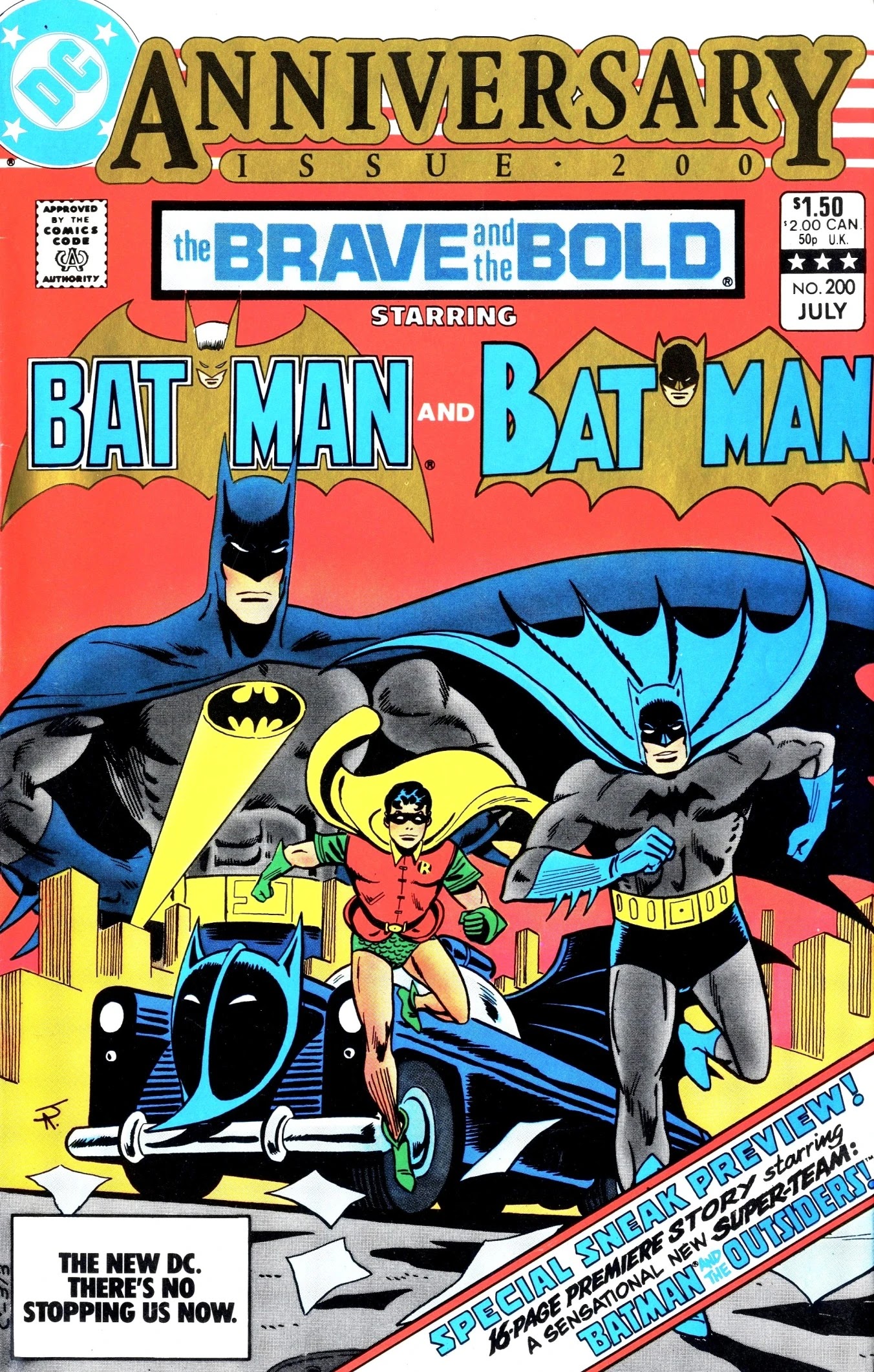
Story Title:"Smell of Brimstone, Stench of Death!"
Penciller: Dave Gibbons
Writer: Mike W. Barr
Inker: Gary Martin
Letterer: Dave Gibbons, Gaspar Saladino
Colorist: Adrienne Roy
Trey: This comic was the end of the road for The Brave and the Bold, a series that started in 1955. It was initially an anthology book of adventure strips featuring the likes of the Silent Knight, the Viking Prince, the Golden Gladiator, and Robin Hood, but with issue 25 it got a makeover as a "try out" book for new concepts/characters. The original Suicide Squad got their start here, as did the Silver Age Hawkman, and then in #28 a little group you may have heard debuted: The Justice League of America.
With issue #50, it became a team-up title, and with issue #74, exclusively a Batman team-up book. The title was the first to feature Neal Adams on Batman and the place where Adams' redesign of Green Arrow debuted.
I didn't know any of that stuff when I read this issue as a kid, though. What captivated me about this issue was this was the first place I was exposed to the idea of Earth-One and Earth-Two. Here was a Batman and Robin that acted like the ones I was used to in the cartoon, and then this darker, serious (and somehow sadder to 10 year-old me due to his Robin-lessness) other Batman.
Jason: The contrast between the golden age pastiche and the state-of-the-art early 80s Batman (and the Earths portrayed here is stark, both in style and substance. I felt a pang that the kinder, gentler, zanier Batman of old depicted here was by this time no longer available in the comics. The Earth-Two stories I remember from the Adventure Comics a handful of years before this were as modern and "adult" as anything else on the stands at the time. Earth-Two Batman was already officially, canonically "dead", at least as much as can be managed in the comics!
Trey: In the main story, Earth-Two Nicholas Lucien is a B-grade villain with a devil gimmick who is defeated by Batman and Robin and put into a long coma by a head injury. He revives 28 years later in Arkham to find himself an old man, and Batman dead and thus beyond his vengeance. Unwilling to accept this, he mentally reaches out to that other him he always sensed existed, a respectable businessman on Earth-One. He essentially possesses that version of himself to execute a terroristic plan to lure Earth-One Batman into a trap and kill him.
And then, there was a preview for a brand new comic! Batman and the Outsiders. New comics with a whole slate of new (some just to me, some completely new) characters. That was not the sort of thing that happened every day, in my experience.
Jason: Indeed! With no generic filler or reprints, this special double-size issue delivers bang for the buck admirably, especially for its era.
Trey: The main story isn't as mindblowing as I found it to be as a child, but I still think it's a good one, in no small part to Gibbons shifting art styles for Earth-One and Earth-Two. I also think Brimstone as a good central motif for a Batman villain and could have been used more, though I do like the implication that Golden Age Gotham might have been awash in theatrical criminal wannabes and almost-wases. I also think it's a nice twist that the so-called World's Greatest Detective never knows what exactly was going on here.
Jason: The opening pastiche sets the tone for the level of realism one is to expect from this incarnation of the Caped Crusader. By the time we're asked to swallow the whole possession from another, more cartoony reality angle, the premise seems perfectly reasonable in the context of this tale and we need not ask questions. The Golden Age sequence was delightful, and the incrementally more sober Late Bronze Age sequence delivered as well.
Gibbons turns in a hell of a job here. His trademark precision and beautifully rendered backgrounds, his eye for meaningful details (one of the hoods' cartoony cauliflower ear, etc.), and his ability to present multiple styles that transition seamlessly elevate this work and render harmless any flaws in the story. It's an early career tour de force, I tell you!
Trey: It's also billed as a Batman and Batman team-up, but the two Batmen never meet.
Jason: The cover is nebulous enough to fit within the ethical standards of comics of the day. It doesn't actually guarantee anything. Never trust a cover, as the savvy spinner-rack devotee of 1983 already knew!
Story Title:"Crystal Visions, Shattered Dreams";"Empires Made of Sand"
Plotter/Penciller: Bo Hampton
Scripter: Dan Mishkin
Inker: Scott Hampton
Letterer: John Costanza
Colorist: Tatjana Wood
Trey: Swamp Thing was created by Len Wein and Bernie Wrightson for House of Secrets, but somewhat retooled, starred in his own series from 1972-1976. In 1982, with a movie by Wes Craven on the way, the series was revived. This series, and perhaps the character in general, is best known for the run by Alan Moore, mostly with Steve Bissette, but there were 20 issues of the title before that creative team came together. Most of them were scripted by Martin Pasko, but there was this two-parter where another writer stepped in, Dan Mishkin, joined by the Hampton Brothers, Bo and Scott, on art. These issues happen to be my first exposure to Swamp Thing comics as a kid.
One interesting thing about this issue is the origin of the villain here parallels the Swamp Thing’s origin—and this being the Bronze Age, they don’t fail to clue you into that fact even if you have no prior knowledge of the character!
Jason:As a kid growing up in a one-spinner rack town, the editorial practice of endlessly recapping prior issues and origins in ongoing stories actually served its purpose, as I often didn't have the opportunity to get consecutive issues of comics. Early 80s pocket money being what it was, I sometimes had to settle for a single issue of the Micronauts after squandering my quarters on the most fleeting of video game thrills (damn you Centipede!).
As in this issue, the origin recap also gives the current art team a crack at presenting the story in their style. The Hampton brothers, both of whom were in their early 20s at the time of publication, provide as seamless a transition from Thomas Yeates as readers were likely to get, as they both embody a classic comic strip and illustration style. The EC Comics influence, especially Al Williamson (and Frazetta), is strong and appreciated by me!
Trey: One thing I appreciate now but I didn't appreciate at the time was how much this is a Phantom Stranger story. He's obviously a guess star, sure, but the structure of the story is very much like the Phantom Stranger backups by Barr and others that had been running in earlier issues of Swamp Thing: the Stranger introduces the situation as narrator. He then intervenes at points, trying to get characters to do the right thing. This playing with the conventions of DC horror anthology titles in a more different sort of narrative is something that Alan Moore would do in his run. In many ways this story is in line with his approach.
Jason: While it will still be a sea-change when Moore takes over, the book is already moving in a more adult oriented direction as evidenced here. Not quite there, but still better than I expected.
Trey: What I also didn't recall is how poorly fleshed out the bad guy's plan is! I mean, sure he's made of living crystal, but other than them both containing the element silicon, how exactly will that enable him to control computers and rule the world?
Jason: Well, we see it all happen right there! I mean, silicon. Computers. You know! Seriously, that's the trouble with comics struggling through these growing pains. Swamp Thing is still a weirdo-of-the-month Frankenstein vs. Dracula book and you're asking it to make sense?
Trey: This post debuts a new feature here on the Flashback Universe blog. Jason and I thought we'd take a break of watching old TV shows and get into...reading old comics! Which, I have been doing a lot of anyway. In it, we're going to discuss some comic, probably from the Bronze Age. First up, the second appearance of Ambush Bug.
Jason:Trey, as the only person I know who has undertaken a systematic reading of DC Comics' output in the years leading up to Crisis on Infinite Earths, you are uniquely positioned to speak to this issue in relation the slow transition from the late Bronze Age to whatever comes next.
While merely an okay, readable, perhaps entirely forgettable comic of its day, I think there are at least tonal elements that mark it as (slightly) ahead of its time. Am I all wet?
Trey: Having read every other comic DC put out that week (and the week after for that matter) I can say these Ambush Bug appearances are atypical. I think that's down to Giffen (Ambush Bug's creator) taking his first forays into writing.
Jason: It feels like Giffen stands on the precipice of nailing down a humorous approach to superhero comics that will see fruition several years later in his highly successful Justice League run (written in collaboration with J. M. Dematteis). The arch tone is in place, but this is an early attempt.
Trey: I think you are right, though first he's going to go to his more overtly comedic collaborations with Robert Loren Flemming in the Ambush Bug limited series.
Jason: Do you think Giffen's use of humor is, in part, a tribute to or revival of the light, sometimes wacky sensibilities of DCs Silver Age?
Trey: That's an interesting question. I'm tempted to say no to revival, but I do think there's is a bit of celebration in its goofiness at a time when comics were becoming more serious. Unlike later works which will try to rehabilitate it, though, I think here in the 80s the approach of doing that seems to be to (lovingly perhaps) make fun of it.
Jason: I thought the running gag involving the never resolved fate of Stoneboy was the most successful and most "modern" use of humor in the story.
Trey: Well, you should read the Legion of Substitute Heroes oneshot from Giffen/Levitz in 1985, because there's more of that!
Jason: Giffen's art is in a transitional phase as well, somewhere between his Kirby-derivative Marvel period and his incorporation (some would say "appropriation") of the influence of Jose Munoz a few years later. I always enjoy an homage to Joe Shuster's slit-eyed style, and Giffen brings out this retro-Superman's old school charm.
Trey: Yeah, it's good stuff, I think, though he has quite perfected the look of Ambush Bug, I don't think. It gets better.
Created bySam Rolfe, Herb Meadow Starring:Craig Stevens, Lola Albright, Herschel Bernardi, Hope Emerson, Byron Kane Synopsis: The man known as "Paladin," a gentleman gunfighter, makes his living as a troubleshooter-for-hire in the Old West.
Trey: The television version of Have Gun – Will Travel aired on CBS from 1957 to 1953. Interestingly, there was a radio version starring John Dehner as Paladin which debuted on November 23, 1958, making Have Gun – Will Travel of the few shows in television history to spawn a successful radio version, instead of the other way around.
We watched Season 3 episode 1 "First, Catch a Tiger" on YouTube. In this episode, two of the three men responsible for hanging Jacob Mordain's son have been gunned down, shot in the back, by the assassin, Fred Horn. The third, Paladin, is invited to Wyoming to face him, and finds himself staying in a hotel with three other men, unsure which is the killer.
I have heard a few episodes of the radio show on radio classics. I must admit having Richard Boone in the lead had kept me away from the TV version a bit. The urbane air of John Dehner seems to fit the character for me. Boone is familiar to me as the heavy in Westerns like Big Jake and The Shootist or more rough-hewn characters like in Rio Conchos. I guess there's always his role in The Last Dinosaur, but anyway nothing makes me think "gentleman gunfighter."
Jason: Bonus points awarded for Boone's ability to pull off that mustache.
I'm also a fan of his rugged not-so-good looks as a breather from today's relentless beauty.
The well-established relationship between the Western and Chanbara genres really jumped out at me in this episode. Paladin, Mordain, and the three possible assassins are all bound by rigid (if idiosyncratic) codes of honor without which, we would have no plot. Paladin voluntarily checks into a hotel full of hostile parties, not least among them the proprietor, and hangs out awaiting an inevitable attempt on his life with all the grim dispassion of Mifune's Sanjuro munching on rice balls in a town full of cutthroats.
Trey: All of the additional cast here are classic TV stalwarts. No particularly other roles jump out at me, but I know I've seen them all before.
Jason: Hollywood legend Ida Lupino directed this episode, and it feels richly cinematic despite the economies of tv production. It looks damn good (and I was grateful for the image quality of the scan we watched) and Lupino's visual storytelling choices shine. When violence breaks out, while kept relatively bloodless for television, it hits hard. The fistfight sequence was pretty epic!
Trey: Indeed! Despite my prejudices against Boone, I liked him in this, and I enjoyed the episode overall. In fact, I wish there was more of it! It's really too short to build much tension, and tension is what it's plot needs.
Jason: We agree on Boone and the episode, though in regard to your previous criticism, I may have felt the tension more keenly. Or maybe after reviewing shows like M Squad and Peter Gunn, I've become some kind of 30-minute drama format knee-jerk partisan!
Starring:Claude Akins, Frank Converse Synopsis: A crusty, veteran trucker teams up with a younger, college-educated co-driver to haul cargo across the country and get into adventures.
Trey: This concept debuted as a made for TV movie In Tandem that aired on NBC in 1974. It was in the style of shows like Route 66 that featured the main characters traveling around and getting involved in the drama of the lives of people they met, and road the growing wave of trucker interest and mystique. Despite a theme long by Merle Haggard and reportedly being President Ford's favorite TV series, Movin' On last only two seasons.
We watched the first episode of the regular series, "The Time of His Life," in which Will and Sonny stop to help a young truck driver (played by Michael Pollard) after he almost runs them off of the road. When they find that he is terminally ill, they determine to show him a good time before he dies on a trip to Portland.
While this could easily have been a setup for an action show, based on this episode, this show seems to be more drama. In this case, lightly humorous drama.
Jason: There was a bit of rough and tumble trucker fisticuffs here and there, but it was not the focus, rather a natural consequence of the mores on display here. The 1970's trucker mystique phenomena puzzled me as a child, but its appeal makes sense in retrospect. America needed an iconic stand-in for the increasingly problematic cowboy and the rambling trucker fit the bill, with a touch of the outlaw thrown in especially due to the cop-thwarting capabilities of citizen's band radio. Speaking of outlaws, Merle Haggard's theme song only helps here, with explicatory lyrics and some tasty finger-picking guitar.
Trey: Akins and Converse are a good pair in the lead roles, but Pollard's Joe Shannon is the character this episode spends the most time on. Due to his baby face, Pollard played a lot of "kid" rolls in the 60s, including in the Star Trek episode "Miri." He's also good in Bonnie & Clyde.
Jason: Pollard is a talented actor especially suited to misanthropic/outsider roles. His career reminds me a bit of Jackie Earle Haley (previously noted in our survey of the Planet of the Apes tv show here), often projecting a more than a bit creepy vibe in his portrayals.
Trey: One thing I found interesting here was the story leaving Shannon's presumed death completely off stage. The way these stories typically go is to make the light-hearted moments bittersweet, by showing their end. Not only does Shannon not die before the credits roll, he isn't even notably sick by the time the episode ends. It's an unusual choice for this sort of plot.
Jason: I too was surprised when the episode came down to its final minutes at the lack of a hospital room sequence (and I may never know if Claude would have conjured up a single, manly tear for the occasion). My biggest surprise was the overall watchability of the gentle, slice of life drama.
Trey: Yeah, it feels very 70s in that way. The stridency of the 60s was past, so no one is getting hassled by the man, and the brashness of the 80s has yet to arrive, so there are no goons working for trucking syndicates to contend with. It's people just living life and getting by.
Jason: Moving on, if you will!
Past as a Foreign Country Dept., exhibit A: While demonstrating dating techniques to Pollard, middle-aged Akins approaches a young woman at the arcade shooting range and wraps her in an unsolicited embrace to ostensibly provide shooting tips. This actually goes quite well.
Trey: Don't try this at home, guys! For those of you wishing to learn more about this series, here's an interview with one of the creators about it.
Starring: Michael Bell, William Callaway, Ed Gilbert, Chris Latta, Neil Ross,
Richard Sanders Susan Silo
Synopsis: Earth Corps, a team of scientists/explorers and their nonhuman allies are the surface's only defense against ancient, evil monsters from beneath the Earth.
Trey: Inhumanoids was a Hasbro toy concept developed initially by Marvel's Tom DeFalco, then further refined by Flint Dille. As was common in the 80s, there was an associated animated series to sell the toys by Sunbow. The cartoon began as a series of seven-minute segments on the Super Sunday anthology series, running to 15 installments that were later combined into a movie, which was then in turn split back into five half-hours and coupled with eight brand-new shows to form a complete season of thirteen half-hour episodes.
The toys sold well, but not as well as Hasbro wanted using the success of G.I. Joe and Transformers as a metric, so it was cancelled. This had the effect of giving the writers of the cartoon a relatively freehand to go in a more horrific direction and more serial rather than episodic in its storytelling. According to Wikipedia: "Visually, the show was distinctive for its application of heavy shadow, use of split screens, and sometimes brow-raising for its graphic content, such as monstrous amputations or writhing deaths by toxic waste, which would be hard-pressed to sneak their way into contemporary 'children's hour' programming."
We watched the first two half-hour episodes.
Jason: I was a teenager when Inhumanoids hit the then-smaller screen, but I still cared about animation (and SF&F subject matter) enough to peek at new things here and there, if only to end up sneering. I peeked at Inhumanoids and sneered contemptuously.
The monster designs appalled me, and their voice-acted shrieks repelled me before I could even begin to perceive the distinctive qualities that set it apart from other adventure-oriented animated series of its day. Which isn't to say what I witnessed in watching the first two episodes was necessarily good!
The animation itself was limited, as TV animation almost always was, but the speed of the editing mitigated this a bit. The images were well executed, matters of taste and design aside. I will however never get over the ludicrous design of D'Compose, and his name isn't helping a tiny bit either. Those Barn Doors of Forlorn Encystment on D's chest and his Godzilla skull with glowing fangs and teeth are all toyetic as anything, but the whole exquisite corpse-style of design was in this case the magic bullet that assassinated my suspension of disbelief.
Trey: I will grant the silliness of D'Compose as name. As to the design, I'm going to disagree--a bit. The simplicities of the animation does it no favors, for sure, and I can't deny its fundamental tokusatsu "monster of the episode" character, but I think there is a mythological undercurrent to D that the other two (being pure pulp monster riffs) lack. In his skull I see echoes of Mari Lwyd and in his snapping rib cage, Tezcatlipoca.
I think it's fair to say a mythological monster in such a pulp/kaiju world is a dissonant choice, certainly.
Jason: Point taken! As you mentioned, Inhumanoids had no qualms about (making an attempt at) scaring little kids to death! In general, tv cartoons of the era, when they tried to be scary, swiftly reassured audiences that there are no such things as monsters and order is always restored by the end of the episode. Not so in the world of Inhumanoids, a series designed to sell a line of toys to small children.
The storytelling in this show was unusual in its speedy pace, due at least in part to the original short format used for the Super Sunday compilations. As a result, the cuts were quick from shot to shot and scene to scene, somewhat jarringly so I thought. This condensed format had the effect of creating a firehose of narrative that advanced the plot visually and kept the dialogue minimal, to the point of confusion at times. If the story was to be understood by kids, their full attention would be required, which is actually a plus in my book.
Trey: Yeah, there's very much a movie serial style rush from one peril to the next.
Jason: By the end of episode two, though, an impressive amount of world building has unfolded. It's unlikely but not impossible that if I sat still long enough to take this material in as a teenager, I might have found myself at least somewhat intrigued. Alas!
Trey: If there was ever a property that could benefit from an adult, film or TV series reboot, I think this one could bear the conceptual load.
Created byDennis Spooner and Monty Berman Starring:Stuart Damon, Alexandra Bastedo, William Gaunt, Anthony Nicholls Synopsis: Three agents for the UN law enforcement division Nemesis get superhuman abilities after being rescued from a plane crash by a secret civilization in the Himalayas, and then use their abilities to take on threats to world peace.
Trey:The Champions is a British seriesbroadcast in the UK on ITV during 1968–1969 and in the U.S. on NBC, starting in the summer of 1968. Dennis Spooner created the series, working with producer Monty Berman. The two would also be responsible for the later series Department S and Jason King. They would use writers on this series that had previously worked on The Avengers and Danger Man.
We watched the first episode, "The Beginning," on YouTube. It introduces the three Nemesis agents, Sharron MacReady, Craig Stirling and Richard Barrett, who crash in the Himalayas after an escape from a bioweapon facility in China. They awaken to find their injuries mysteriously healed. Soon, they learn they have had new abilities bestowed on them by their rescuers, the people from a hidden, ancient civilization. The evade capture by the Chinese military and return to Europe having completed their mission.
First thing, I was struck by a few parallels with the Challengers of the Unknown who debuted in 1957. A plane crash is the pivotal event that changes the course of their lives, and the Challengers' refrain that they are "living on borrowed time" is voiced by one of the Champions just after the crash. Then there's then names they are just similar but seem to fit together: the challenger takes on the champion, after all.
Jason: I noticed those similarities and perhaps a wee bit of the original Doom Patrol, if only in the manicured beard of their agency commander. Speaking of the names, I thought the three starring actors had better names for the genre than the characters!
For a spy-fi show with a touch of plain-clothes superheroes thrown in, I found it quite effective, despite budgetary limitations.
The plane crash sequence was suspenseful despite the use of miniatures and a foregone conclusion. The fight scenes worked well despite the small soundstage and put me in mind of a less expensive Star Trek.
Trey: I enjoyed the show quite a bit, too. It had the standard sort of groovy Brit style of the era and an intriguing concept. I'd be interested to see what more episodes are like.
Jason: I especially like its successful threading the needle of earnest adventure story with its tongue positioned in precisely the right part of the cheek.
Trey: My only quibbles might be there didn't seem to be enough of it! I think it would have been better served by a two-hour pilot, and maybe a central villain of the episode.
Jason: The production staff may have shared your concerns and sought to correct in future episodes. Perusing an online episode guide alerted me to the fact that episode 2's special guest antagonist was none other than Peter Wyngarde!
Starring:Peter Falk Synopsis: Rumpled and unassuming Los Angeles homicide detective, Lieutenant Columbo, doggedly reveals even the most well-concealed of crimes.
Trey: Columbo had two movie "pilot episodes" in 1968 and 1971, then series aired on NBC from 1971 to 1978 as one of the rotating programs of The NBC Mystery Movie. It was brought back in the 80s on ABC on a sporadic basis from 1989 to 2003. That's when I became acquainted with it.
Columbo was partially inspired by Fyodor Dostoevsky's Crime and Punishment character Porfiry Petrovich as well as (according to Wikipedia) G. K. Chesterton's cleric-detective Father Brown.
The first episode of the 1971 series follows the (at the time) innovative formula of showing the audience the crime from the beginning, thus removing the mystery ask, except in regard to just how Columbo will eventually catch them. It was written by Steven Bochco and directed by Steven Spielberg. In the episode, a member of a mystery writing duo resorts to murder to break from his less talented partner.
Jason: I remember the presence of Columbo in the pop culture of my childhood but don't recall ever having seen the show in its day, possibly due to the draconian bedtime I strove against in my single-digit years. For decades, references to the series and impersonations of Falk were ubiquitous. I've previously mentioned my general lack of interest in the crime drama genre which, like many things, was once strident but has softened over time. I enjoyed this chance to better acquaint myself with the series and character that became, for all intents and purposes, iconic.
The young Spielberg wastes no time distinguishing himself with a cinematic approach and clever visual storytelling even as the credits roll. While perhaps trying a bit too hard at times, the episode amounts to a very effective portfolio piece. Somebody give this kid a feature!
Trey: Yeah, I think he's got something and is going to go places. Wonder whatever happened to him? I'd also call out writer Steven Bochco as the creator of Hill Street Blues, L.A. Law, and NYPD Blue among other credits.
Jason: The titular character doesn't show up until nearly the 20 minute mark, as goes the show's formula, and he doesn't disappoint. As everyone already knows, Falk is uniquely charming in the role.
His opponent, as expertly portrayed by Jack Cassidy, couldn't be more arrogant, slimy and unlikeable, despite his sophistication and impeccable manners. The rest of the cast give naturalistic performances, leaving it to the leads to provide the understated climactic fireworks.
Trey: In latter series, they did a lot of celebrity casting of the "murderers of the episode" and that and the focus on their viewpoint sometimes gives you (or at least gave me) a bit of sympathy for them: "Alright, alright, Columbo. They're guilty! Quit playing with them and arrest them, already!" Not here, though.
Jason: As an unsophisticated newcomer to the genre, I give this show high marks. I'm tempted to watch more.
Unlike many of the shows featured here in the Flashback Universe, this one is anything but obscure and much ink has been spilled on its behalf. I found this article to be an effective expression of the warm regard Columbo still enjoys. Exhibit A: BBC Why the World Still Loves the 1970s Detective Show Columbo. Oh, and here's a Columbo statue in Budapest, Hungary. My only regret is that his dog doesn't appear in this episode!
Starring:Richard Webb, Sid Melton, Olan Soule Synopsis: Captain Midnight of the Secret Squadron flies around the globe in his jet the Silver Dart, fighting various criminals and spies with his sidekick Ichabod Mudd and aided by a scientist, Dr. Aristotle Jones.
Trey: Captain Midnight (later renamed Jet Jackson, Flying Commando on TV) is a franchise that debuted as a radio serial in 1938. The character's popularity throughout the 1940s and into the mid-1950s saw him appear in movie serials (1942), a syndicated newspaper strip (1942), a comic book (1942–1948) and of course a television series (1954-1856).
The series aired on CBS and was sponsored by Ovaltine and Kix/General Mills.
Jason:'ll just go ahead and admit this was a pretty fun watch for me, the heavy handed in-world pitches for chocolaty, vitamin-laden Ovaltine only adding to the goofy charm.
However, it swiftly becomes clear why legislation was enacted in the 1960s to regulate children's television, especially as regards advertising content. But thank your lucky stars that hero of supply side economics, former president Ronald Reagan, rolled back these restrictions, or else we may never have gotten to know He-Man, GI Joe, and Optimus Prime quite as intimately.
Trey: The Gipper made Tv safe for product placement again! This really is a whole number level of undisguised shilling, though. It reminds me of The Shadow radio show and its Blue Coal pitches, except with more kid appeal.
I should mention before we get too far along that we watched Season 2, Episode 3, "The Frozen Men." Noted scientist Dr. Hartley is kidnapped by foreign agents. Captain Midnight, Ikky, and Tut figure out he has been working with extreme cold to make a super-durable metal. There's an atomic bomb dropped in this episode, though not directly on our heroes.
Jason: Spoilers! Anyway, Richard Webb, whose portrayal of a Starfleet officer deranged by the rigors of their duty is forever burned into my memory banks...
Trey: That would be Ben Finney in the Star Trek episode "Court Martial."
Jason: Yes. Here he does an admirably straightforward job of embodying the Cold War American Hero. His jaw is square enough and he delivers lines with the precise diction every Cold War school child should strive to perfect.
His sidekick Ikky, who in this episode at least is in near-constant need of a hot shower, provides the kind of comic relief that might have generated some laughs for children of the 1950s. For us moderns, the humor is barely detectable. I did laugh out loud when, certain his Captain was incinerated in a nuclear blast, Ikky frowns slightly and delivers a somber, momentary salute before immediately moving on with his life.
Trey, the science in this science fiction is worth mentioning I think. You've forgotten more about science than I'll ever know. Can you give us a breakdown on the speculative elements in this episode? I hold no degrees in the sciences, but I'm pretty sure some liberties may have been taken.
Trey: Well, I think the whole idea of super-metal Protonium that is created from nothing by intense is utterly fanciful. Then there's the medication profrigidium that is evidently super-endotherm in its reactions. None of this is science but rather "Science!" as found in pulp media. Of course, that's not even mentioning the 50ss naiveté about the horrors of nuclear bombs.
Jason: I'll regretfully cancel my profrigidium order at the pharmacy.


.jpg)