Tuesday, September 17, 2013

The List of Marvel Bronze Age Licensed Comics

Over the weekend, I was looking for a complete list of all the Marvel Licensed Property (LP) comics from the Bronze Age and after a few minutes of unsuccessful searching I decided to put one together myself.

To narrow things down, I am not going to include one off Movie adaptations or Celebrity novelty comics. I will also not include any of the Star line of comics which included Defenders of the Earth...


... because I plan to write an article on that line in the future. (Note: Fans of the old King Features characters should check out the new King's Watch series written by Jeff Parker from Dynamite comics. I got the first issue and was quite surprised how good it was.

During the 70's and 80's, Marvel was more inclined to publish Licensed comics than they are today. (Though one could argue that since Disney now owns all of Marvel, the entire line is one big licensed entity.)

Star Wars

I bought the first issue of Star Wars at an Eckerd's Drug Store several months before the movie came out IIRC. The words on the cover of issue 1 exclaimed that it was soon to be a Major Motion Picture! At the time, I figured it would be just another one of those cheesy sci-fi movies that no one would like, because there was no way anyone could make a movie that looked as cool as this comic book. When the movie opened, I went and saw it with my folks. I remember thinking, "Holy Smoke! They actually did it!"

Rom

Here's one that is probably in the top 10 list of everyone's favorite Liscensed character comics, ROM is a comic that actually outlived the toy that inspired it. To this day the character has a huge fan following and the Knights of Galador have recently returned in the pages of Marvel's Infinity.

The only thing that has held ROM back from making a reappearance all these years is the complicated matter of Toy rights ownership. With Toys, often a skilled toy designer may negotiate ownership rights with the manufacturing company. When that happens, if there is any doubt about clear secondary market rights, the ambiguity can hold up production in those areas. Many comic luminaries (such as Robert Kirkman) have pursued negotiations to produce a new ROM comic, but to no avail.

Micronauts

This Mego LP comic found inspiration in Star Wars but quickly found its own voice thanks to the fantastic team of Michael Golden and Bill Mantlo.

Tarzan

Most people probably don't remember Marvel's short lived Tarzan comic. A quick scan of the covers will explain why as it seems that Marvel was unable to think of any cover ideas other than Tarzan fighting some sort of jungle creature (which must've looked pretty lame compared to the rest of Marvel's lineup at the time.) They should have explored the Hidden/Lost City themes in the books more IMO.

Star Trek

This series didn't last very long. It was probably the one two punch of an expensive license coupled with a movie that didn't quite meet fans expectations. I think I only bought a few issues before I deemed it not really my thing. I'd be curious to review the series again to see if was as boring as my teenage self thought it was.

Shogun Warriors

One of THREE Herb Trimpe pencilled books on this list. Why these guys have not reappeared in some form during this age of Transformers movies is a bit beyond me. Perhaps the Transformers so successfully stole the Big Robot thunder that Mattel never felt it was worth it to relaunch the property?

Doc Savage

The four color adventures of Doc Savage didn't last very long, being about as successful as The Man of Bronze movie in 1975. Marvel also put out a black and white adventure magazine featuring Doc and his five compatriots, but that had even a shorter lifespan. Over the years, many companies have tried to turn the Man of Bronze into gold, but it seems to be a tough thing to do.

Partly, I blame the approach because I think the general tact is to do the stories as straight adventure stories, which totally makes senses except that like with Tarzan, the adventure stories that fit with Doc Savage all seem a bit tame by todays standards. I think it is no coincidence that Altus Press, the current publisher of Doc Savage stories, has begun taking a more exotic approach with the newer Doc Savage stories.


With that said, Dynamite seems to have successfully turned the Shadow into an ongoing franchise, so I would be interested in seeing how they would approach Doc Savage.

Godzilla

This series is unique in this list as it is the only one for which Marvel was able to publish an Essentials edition. (Click the image to see the Essential version on Amazon.)


Herb Trimpe's tenure on the Incredible Hulk made him the perfect artist to draw another big green skinned goliath who loved to smash things. It didn't hurt that Doug Monench came up with some creative kaiju for the king of monsters to wail on either.

Conan (and all of the other Robert E. Howard properties)

Without a doubt, easily the most successful of all LP comic series Marvel ever published lasting several decades and creating an entire new comics genre. Over the years we would see Kull, Red Sonja and Solomon Kane also get some time in the Marvel universe.

Battlestar Galactica

Despite having some fine artwork from Walt Simonson, this series tends to get forgotten by Bronze Age fans. That may be in part to the darker, horror theme stories which didn't really sync up with the grand space adventure ( Star Wars ) roots of the television series. All in all, the series ran for 23 issus before being cancelled, so it wasn't a total failure.
This incarnation of the property would actually see a comics revival by Dynamite in later decades thanks to the revamp sy-fy series.

Master of Kung Fu (Fu Manchu)

While the Master of Kung Fu himself is indeed a wholly Marvel creation, the reason we don't see any MoKF Marvel Masterworks of Essentials is because the series prominently features Shang Chi's father, Fu Manchu...


Created by Steve Englehart and Jim Starlin, this series was created the comic book rights to Sax Rohmer's villainous Dr. Fu Manchu AND the rights to the Kung Fu television series. Instead of making two separate comics featuring each property, Marvel combined the concepts into one fully fleshed out world which would click with readers for a full 125 issues, making it the third most successful LP comic series on this list.

While creators Englehart and Starlin would leave the title early on, new writer Doug Monench and artist extraordinaire Paul Gulacy would bring the series to a new level of success with stories filled with foreign intrigue, superb art and old movie sensibilities and callbacks. So beloved is the series that in 2010, it was voted number 6 in the list of all time great 1970's Marvel series by the folks at www.ComicsBulletin.com

GI Joe

I'll be honest, this comic came during one of my "out of comics" phases so I know zilch about it, nor have I ever been that interested in any of the newer incarnations. So, with that said, here's what wikipedia as to say about GI Joe:

It was unique at the time in that it was a comic book series that was promoted on television commercials which also supported the toy line. This 155-issue series is considered to be one of the longest-running comic book tie-ins to a toy line. Much of its success is to be credited to Larry Hama, who wrote the entire series save for a few issues with guest writers. Rather than treating the stories as a mere promotion for the toys, Hama wrote the series with seriousness and infused it with doses of realism, humor, and drama. Other than Transformers, no other series was able to duplicate its success. Notable artists include Herb Trimpe, Ron Wagner, Rod Whigham and Marshall Rogers.

~http://en.wikipedia.org/wiki/G.I._Joe_%28comics%29#Marvel_Comics
At 155 issues quite a number of spin offs and special issues, GI Joe is easily the second most successful LP comic.

John Carter of Mars

Our second Edgar Rice Burroughs entry in this list, this series ran for 28 issues and 3 annuals, all of which take place within the timeframe of the third and fourth paragraphs of chapter 27 of A Princess of Mars

Drawn by Gil Kane, Carmine Infantino and Larry Hama with stories by Marv Wolfman and Peter B. Gillis, this fine series has been collected in a hardcover omnibus (most likely to capitalize on the hoped for success of the JCM movie.)

Long time followers may remember I once posted a Golden Age version of the John Carter comic previously on this blog.

Transformers

What began as a 4 issue limited series proved so successful that it lasted over 6 years, a point not missed by Marvel editorial as the last issue proudly proclaimed #80 IN A FOUR ISSUE LIMITED SERIES! Originally helmed by Bill Mantlo (who did such a fine job with the Micronauts) Jim Salicrup and Bob Budiansky saw the book through the first year with Bob taking over sole writing chores until issue 55 when UK Transformers writer Simon Furman took over. Furman would remain on the title until its final issue.

I'll wrap this up with two final LP Comics that started out as movie adaptations but grew into something more.

 Logan's Run


Logan's Run was more like a sprint as the series only managed last 7 issues. While the first five issues initially recapped the movie the book continued Logan's story with original content for a few issues after.

Art afficianados take now: The recap issues were pencilled by George Perez.
Also of interest is a Thanos solo back up story that appears later in the series.


2001 A Space Odyssey

2001, helped by the incredible Kirby artwork survived a bit longer thanks mostly to the introduction of a more interesting character who wasn't in the movie at all: Aaron Stack aka Machine Man. (Note: how many of your readers how there recognize Machine Man's alias as a pun on the early computer syntax warning Error On Stack?)


Two final notes:

In review of the post, I see I took a rather scattershot approach to my commentaries leaving out the creators and series length in many cases. I'll get around to fixing that in time.

Also, if I missed a series, please let me know in the comments section below!

UPDATE: Sharp eyed commenter ShadZ noticed I had left off Marvel's Indiana Jones series which apparently ran an impressive 34 issues.


From wikipedia:

 In 1981, Marvel Comics published a three-issue adaptation of Raiders of the Lost Ark. In January 1983, they gave the character his own monthly series, named The Further Adventures of Indiana Jones, which ran for 34 issues until March 1986. The series had Marcus Brody and Marion Ravenwood in regular supporting roles, and Sallah, Katanga and Short Round also appeared. A three-issue adaptation of Indiana Jones and the Temple of Doom, and a four-issue adaptation of Indiana Jones and the Last Crusade, were also published.

Thank you ShadZ!

More Updates from several new comments reveals quite a number of comics I forgot:

First, Jean-Paul Jennequin reminds me that Dr. Who had a short run in the pages of Marvel Premiere.


Jean-Paul also asks would I include comics like Kiss and Alice Cooper, but I think I will save those type of comics for another article.

 DD Degg calls forth one I forgot that I'm both shocked and embarrassed to admit - Marvel's Planet of the Apes series!

This series also had a run in the B/W Magazine format (as did Doc Savage)


Degg also brings word that Thongor was a licensed comic featuring a Lin Carter creation, which up to now, I never knew.


I'll try to round up some details about this newly added comics soon. In the meantime, keep the suggestions coming!


- Jim

Sunday, September 8, 2013

The World of Archie


Last week, while in the grocery checkout line with my daughter ( age 8) she asked if she could get an Archie Digest. Like most comic loving dads, I am overjoyed anytime she expresses any interest in my hobby, so of course I said yes.

There were several to decide from, but this is the one she settled on:


It cost $3.99, which was quite a bargain considering all the story content that came in the digest. My daughter picked it because she liked the fairy tale themed story she glimpsed while flipping through the issue. She also saw it contained Josie and the Pussycats who she likes as well.


TBH - I was actually surprised that they still sold Archie Digests. I was a bit like my friends at work who are always surprised that comic books are still sold. I've probably passed by Archie Digests many times over the years, but just sort of figured they had moved out of the grocery stores. Usually, when I'm in the grocery store, it's by myself, picking up less than 10 items, so I don't stand in the line long enough to really note what in the racks.

I think I also just naturally assumed the general downturn in sales that has affected the superhero comics market may have affected Archie comics. Which got me to thinking just how ARE Archie Comics doing these days?

Fortunately for me, Johanna Draper Carlson over at ComicsWorthReading has done all the heavy lifting.

The first thing I saw was that, yeah, the singles/pamphet editions sell pretty much about the same as your average C list superhero title (think Ms. Marvel or Blue Beetle) in the 7K to 15K range. Also, sales of titles have dropped quite a bit each year.

Archie, the flagship title, which sold 27K in the 2007 dipped down to 13K in 2008 (the beginning of the recession) and is now only climbed back up to 15K.

Betty and Veronica, another staple of the line, was at 17K in 2007 and is now only 9K!


Many titles have been cancelled altogether over the years (Archie & Friends, Jughead, Sabrina, etc...) Based on the ComicsWorthReading article, 9K is the historical cancellation mark for an Archie title, so if that is true, Archie comics only has one title NOT in the danger zone for cancellation now!

The digests do much better (as one might suspect given their higher visibility in stores) with a range of 46K for Archie Digest down to 37K for Jughead Digest. The only problem is, Archie comics publishes a LOT more of each digest than they actually sell with the percentage of sales to publishing running around 26% sell through.

That's also a number that has dropped over the years. Back in 2010, the digests were selling at a rate of about 40% published. In 2007, Archie Digest sold 97K. The Jughead Digest sold 82K.

Which leads me speculate on the causes (which I think or many)
  • Over the recent years, we've seen a decline in traditional grocery store chains as Wal-mart superstores spread. This would decrease the number of racks the digests could be placed on.
  • As the CWR article seems to indicate, the recession took a huge toll on the digests. No doubt the $4.00 books became less of an impulse buy to cash-strapped shoppers.
  • Tablets and cellphones, with their infinitely more engrossing apps have found their way into the hands of young kids. Now, you don't hand a kid a comic book for a long trip, but let them play with your phone instead.
I'm willing to bet that the downturn in sales is behind some of the recent "Stunt Casting" and Gimmick issues of late (Glee, Kiss, Archie Marries Betty, ect...)


I suspect those novelty issues are doing pretty well for them on several levels, so I wouldn't count the gang in Riverdale out just yet.

Which for my daughter (and me) is a good thing! :)

- Jim

Sunday, September 1, 2013

The New Age of Sci-Fi Comics

Is the comics industry be entering a new science fiction revival? Looking at sales figures and the number of sf titles, it feels like the type of sf comic boom not seen since the 1950's.


Consider this range of sf comics from several publishers over the last few months.


Reviewing monthly sales figures for the titles above which showed up in the top 300 shows us a genre that seems pretty healthy.

Guardians of the Galaxy is in the top 10. Albeit, that is more a conventional superhero title than a sf title, but it does open the door for other sf comics at Marvel in some ways.

Saga is in the top 30 (and the August issue may have even broken the top 20) with the trade collections tearing up the charts. East of West is in the top 50 at 42. The third issue of The Wake came in at 82.

Some of the above sold out (like Trillium) but because we haven't seen the August sales numbers, it's difficult to say what sold out means. Still, when was the last time a Vertigo comic sold out? It's beginning to look like DC's decision to increase it's sf comics was a good one.

What's behind this trend? I suspect it's a bit of superhero burnout among current fandom combined with the expanded reach of digital comics bringing in science fiction fans. As it's been suggested, the impact of digital comics is additive, so people who discover Saga or Prophet on Comixology can quickly become trade paperback buyers.

So, will this trend continue? The last time we saw a real boom in science fiction comics was when DC cranked up the Helix imprint in the 90's.


Which is coincidentally the same time that Marvel's Guardians of the Galaxy was going through a new incarnation.


The Helix imprint didn't last long, but Transmetropolitan rolled out of into a very successful run. I hope many of the titles I mentioned above can run that long.

- Jim

Sunday, August 25, 2013

Are Your Bronze Age Comics Worthless?

Last week there was a story on comicsbeat.com entitled Why your Bronze Age comics collection ain't worth squat!
 

The story quoted one of the stars of American Pickers (Frank Santoro) as he explained why Bronze Age comics aren't worth much nowadays...
It’s a typical collection that you see floating around now. Classic Bronze Age. A run of Marvel Two-In-One. A run of Micronauts. A run of Alpha Flight. A run of Camelot 3000. Badger. Nexus. Web of Spider-Man. A good selection of valuable X-Men. A good selection of worthless Cloak and Dagger. But nothing interesting like Elektra: Assassin or Slash Maraud. You know the drill.
“How old is Tommy?” I asked.
“42,” sayeth Uncle Louie.
“Yeah, that makes sense. See, what’s happening is all the guys your son’s age are dumping their collections now. They all had the same books. So the market is flooded.”
Note: As fellow fan of the Bronze Age Trey Causey pointed out, a lot of the comics he mentions aren't really Bronze Age at all, but the question remains.

As one might imagine, the comments section quickly filled with other Bronze Age fans sharing stories to confirm the notion. I thought I would share my experiences in this area over the years as from time to time, I've dabbled in flipping old comics and runs.

Back in the early 2000's, when I was self-employed, I had the time to scour ebay in search of cheap comics with which to put together complete runs. (Which sold very well at the time.) With a little work, you could scoop up issues of, say, Batman and the Outsiders or Freedom Fighters in separate auctions for about a quarter a piece. (You always had to watch out for people who gouged on shipping.)


Once assembled, you could then turn around and sell the complete set for anywhere from one to two dollars an issue. (Or in some cases, like a complete set of FOOM, which took forever to acquire, I might charge more than that.)


However, around 2005, I started to notice that I was getting less and less watchers on my ebay auctions. As the years progressed, it became even harder for an auction to complete all the way. On the flipside, it was becoming easier and easier to pick up the single issues in what I would call "dump" auctions (auctions with lots of random comics.)

I think part of the problem is that people can now pick up old comics so easily in all sorts of Collected Editions.


The other problem is as people transistion to reading their comics digitally, it is becoming much harder for them to justify buying old paper issues (especially if a large portion of their house is already devoted to a storing their collection.) In some cases, when inspired to read older stories, the newly converted digital fans are looking for them not in musty long boxes but on torrent sites instead.


I've even noticed ebayers picking up on this trend by offering digital collections of old comics on DVD. (In the screenshot from ebay below, the Spider-man DVD Rom might be legit, but the Phantom and Green Lantern collections aren't.)


Even with all those odds against them, a casual search of ebay will reveal that quite a number of ebay auctions where Bronze Age comics still sell at respectable prices.

So, in answer to the question posed by today's post title, I would say while calling Bronze Age comics worthless is quite an exaggeration, they have definitely lost some value among some potential buyers.

With all that in mind, here are a few tips for getting the best price for your old Bronze Age Comics:

Shoot a picture of your item on either a clean background (like a white sheet) or on bubble wrap. It sounds silly, but a picture on bubble wrap sends a buyer the subliminal message that the item is ready to ship and will get to them very quickly.


If you are selling a complete run of comics, scan and show buyers each and every cover. This is good for two reasons. One, the cover art will help entice them into making the decision to buy the issues and two, it will help you field complaints if one of the covers is not in perfect condition.

Always offer free shipping. If that sounds extreme, remember than media mail usually only runs about $5.00. If you aren't making enough profit in your auction to cover that cost, you need to up the number of comics you are selling in the auction.

Try to capitalize on any current trends in current comics. Like for instance, right now, with of an Inhumans movie and their prominent appearances in Marvel Infinity, this would be a great time to try and move a complete run of some older runs of the Inhumans.


Those are my tips. If you have other suggestions, please feel free to suggest them in the comments section below.

- Jim

Sunday, August 18, 2013

The Mystery of Apache Chief

Today, I'm reaching out to readers of this blog concerning a question about one of the four non-DC superheroes Hanna Barbera created for the The All New Super Friends Hour in in 1977.

I am of course talking about Black Vulcan, Apache Chief, Samurai and El Dorado (pictured below with Rima who was actually a DC character and the Wonder Twins)


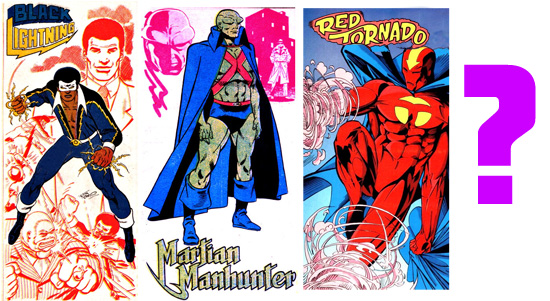
Here's my theory - I think HB want to to give the show a more multicultural feel and here's how I think it went down. HB asked DC if they had any superheroes who weren't white Anglo Saxons, whereupon DC replied with Black Lightning, Red Tornado, Martian Manhunter and someone else. 
 

And while those characters are indeed non-white guys, Hanna Barbera wasn't satisfied with that selection, so someone inhouse was given the task of creating new superheroes for the show. The best candidates were creative producers Ken Spears and Joe Ruby though Jeffrey Scott, writer of the show at the time was unable to confirm this as of 2011. We do know Alex Toth designed the look and feel of the characters.


The Black Lightning/Black Vulcan connection is a pretty much a given as we DO know that Black Lightning was in the original discussion, but was tabled due to a dispute between DC and Black Lightning creator Tony Isabella.

My theory that Martian Manhunter and Red Tornado were the inspirations for Samurai and El Dorado is pretty much based on the similarities in powers.

Samurai was a human tornado like Red Tornado.


El Dorado (whose powers were ambiguous and never really defined in the show) was shown several times using powers shared by the Martian Manhunter (superhuman strength, telepathy.) And where the Martian Manhunter uses phasing, El Dorado similarily uses teleportation.


Even El Dorado's costume, with its open torso design is similar to Martian Manhunter's costume.


My question today is: Who was the inspiration for Apache Chief?


There were a couple of Native American Superheroes in the DC Universe at the time who could be likely candidates...

Super Chief


and Scalphunter


Though neither of them have powers similar to Apache Chief (not necessarily evidence that they weren't the inspirations, but it does seem like a break in the MO.)

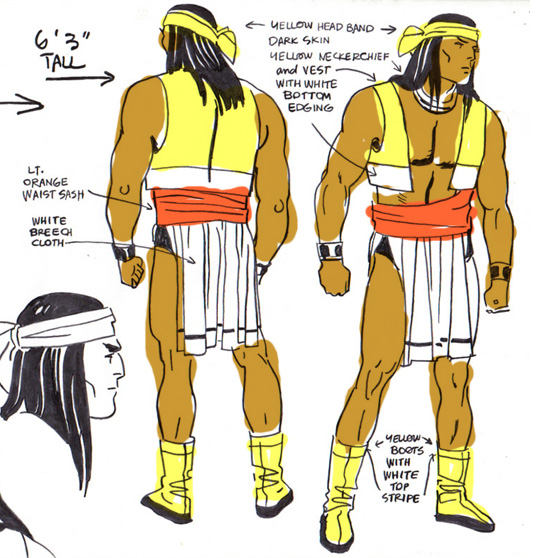
My best guess is that AC was some sort of amalgamation of both characters. His name uses the Chief title but his costume design is closer to Scalphunter's.

Oddly, the back and forth on more multicultural heroes may have paved the way for another Native American character in the DC Universe: Dawnstar. 


Her first appearance was in April 1977. Given that the prior year, talk of Hanna Barbera wanting more multicultural heroes may have been buzzing around the office, it is possible that Paul Levitz and Mike Grell were encouraged (either creatively or editorially) to create a new Native American character.

I also find it interesting that her yellow and white character design so closely resembles the original proposed yellow and white Apache Chief color scheme.


If anyone out there has anymore details about the origins of these characters, I would love to hear from you.

- Jim

Sunday, August 11, 2013

Fake Geek Girls, Heavy Metal Posers and other threats to humanity

Over the past few months, I've watched the turmoil that has arisen from people pushing the term Fake Geek Girl. For those of you new to the term this article from Forbes.com by Tara Tiger Brown sums up the concept:


Pretentious females who have labeled themselves as a “geek girl” figured out that guys will pay a lot of attention to them if they proclaim they are reading comics or playing video games. Celebrities are dressing up as geeks to reach a larger audience. Richard Branson labeled himself a geek for crying out loud.

~Tara Tiger Brown, Dear Fake Geek Girls: Please Go Away
3/26/2012

Here is the catchy counter arguement in video format: 

Nothing to Prove - Geek Girls & The Doubleclicks

My take is this: I'm inclined to think that people who fear the supposed onslaught of Fake Geek Girl hordes are at best worried about the devaluation of whatever Geek Cred they have and at worst misogynists.

I've seen both Fan Boys and Comic Professionals make statements that suggest they think Fake Geek Girls are detrimental to their hobby in some way. I think its telling that the same people who are so down on Fake Geek Girls don't seem to have a problem with Booth Babes. Next time a thread about a con wanting to ban Booth Babes pops up, watch how many people will cry in outrage. That to me reveals their personal agenda: Girls in outfits are okay if they are there to entertain me - not get in front of me in the queue for the next Firefly panel.

I used to see this same sort of back and forth in my Heavy Metal days. Back in the 80's, it was common for some people to call metal fans of a certain ilk Posers. However, the definition of Poser was a very slippery thing. Whenever I would press other metal heads or punk rockers for a clear definition, they would start with how someone might dress a certain way but not truly be into the scene. (Which sounds a lot like the FGG issue, doesn't it?)

In the early 80's the classic image people would give me was guys who weren't in a band, but would dress up like Judas Priest and just show up at rock clubs to look cool.


As the years went by, the definition of Poser changed such that it was now guys who looked like Poison or Guns and Roses but might actually be in a band.
 
The defining difference being that the Poser band was seen as jumping on a musical bandwagon  and weren't playing "Real Metal."


So, what's struggling band supposed to do? Well, try to play Real Metal of course. The only thing is - no one could agree what that meant.

Was it Thrash/Power Metal like Metallica?

Nope. Not if you were a Slayer Fan.
And Slayer Fans were called posers by Celtic Frost fans.
And Doom Metal fans thought that Death Metal fans were all posers.
Ect...

The Anti-Poser mindset was like an Onion. As you drilled down through the layers metal of you would always encounter metal-intelligensia who viewed fans who had not heard of the latest undergound band or long lost 60's pioneers in the genre as inferior.

Comedian and unabashed metal-head Brian Posehn made a video about this very idea:

BRIAN POSEHN - More Metal Than You


Currently, I'm seeing a return to this More Metal Than You attitude as fans of the New Wave of Thrash bands like Evile and Warbringer run up against fans of bands like Black Veiled Brides and Avenged Sevenfold. This sort of thing is ultimately unhealthy for the scene as is encourages exclusionary divisions which make people uncomfortable.

I think that's the danger of the whole Fake Geek Girl mindset. I don't really think there is a vast, far reaching conspiracy of Fake Geek Girls vying for the ever so valuable and long lasting attention of fan boys everywhere. It's just an idea that makes some insecure fans feel superior to people they view as a threat in some way.

As far as I'm concerned, no one gets to set the rules on what a real fan is. The guy who can name every single X-men and the guy who only reads black and white independent comics don't get to tell the fan who just started comics with Marvel Now or the Avengers movie that they are a fake geek.

Trying to exclude people from the hobby because they don't meet your standards as a fan is a real jerk move.

- Jim

Sunday, August 4, 2013

Go Team Comics! 80's Style

Editor's Note: I recently saw this blog referred to as being one of those "Go Team Comics" blogs in a way that I thought was not only a bit insulting but also misguided (given my often critical analysis of industry strategies). However, the comment did inspire today's post title, so I guess even detractors can be a source of inspiration. - Jim

Of late, I've been reading (for the first time) the classic Keith Giffen run of L.E.G.I.O.N. I'm up to issue 18 and I've been impressed with how solid the run is for so long.


Most of the series tends to run in the sci-fi lite realm that most comic series tred in, but what makes it interesting is seeing Giffen play with the Legion of Superheroes mythos (the Emerald Eye, Durlans and the Champion of Talok VIII) in a way that he may have not been able to in the regular LoSH series.

This got me to wondering what other team books from the big two during this era started off so well and kept up the quality for such a long time? Here are five I came up with:

1: John Ostander's Suicide Squad


The premise of villains working as covert government operatives is well trod territory now, but at the time this comic came it was a fresh and exciting idea that Ostrander ran with. While the first arc is a bit rough IIRC, Ostrander gets a better handle on the characters as the series continues - especially Bloodshot, Bronze Tiger and Captain Boomerang as the run plays out. In addition to the fun character work, I enjoyed watching the rogues go from one disasterous mission to another, losing members and gaining replacements every couple of issues.

2: Peter Gillis' Strike Force Morituri


Synopsis: In a future where Earth is at war with a vicious alien race, drastic measures are taken in the form of the Morituri process. Volunteers agree to be endowed with superhuman abilities to fight the aliens with the understanding that the powers will cause early death.

Like Suicide Squad, this series benefits from being able to so handily dispatch and gain characters at a moment's notice. This gives the comic a bit of a frenetic pace storywise which modern readers might find disconcerting, but once you get used to it, it's a fun read.

3: Roger Stern's West Coast Avengers


Back before slapping the word Avengers on every other Marvel comic was a bottom line driven corporate mandate, Roger Stern and Bob Hall developed this interesting title featuring Iron Man (and Hank Pym) leading a group of heroes in California. What the series got right was the involved character subplots that ran issue after issue. Where it was a bit off is with some of the villains (Master Pandemonium for example) who were a bit too D-List at times.

Like most of the series on this list, I either dropped off them at the time or never read them during their heyday because of the economic pressures of college. I think I stopped on this series after the first year or so, but recently a commenter on this blog (Cash Gorman?) suggested I read the John Byrne issues, so that's next on my list after L.E.G.I.O.N.

4: John Byrne's Alpha Flight


In discussing this series with FBU friend Trey Causey, we both agree that the first 12 issues of AF is among the best first year examples of a comic series around. In my mind, the first year is so good that I tend to forget that Byrne continued on it as writer until issue 28 and then Bill Mantlo (another great Marvel workhorse at the time) continued the series until it was eventually cancelled with 120.

One of the things that makes this series so good in my mind is the number of interesting plot twist Byrne brought to the table in the first year. Also, at his creative peak, Byrne was a whirlwind of interesting ideas and with characters like Puck, Snowbird and Marrina, you can see Byrne getting to utilize a lot of the concepts he had built up over the years that might not have fit in as well in the X-men or Fantastic Four.

5: Bill Mantlo's Micronauts


Here is another title where the first 12 issues are just amazing. Obviously inspired by the Star Wars zeitgeist of the time, this series manages to rise above other SW imitators with the help of Mantlo's fleshed out alien worlds and Michael Golden's brilliant visuals. The first year of the series is compelling story of the battle of rebel Micronauts against the Vaderesque Baron Karza. After the battle is resolved, the series tends to drift a bit.

It's always been my opinion that Mantlo (who saw the Micronaut toys at a convention and convinced then EIC Jim Shooter to liscense the brand for a series) viewed the series as a possible movie franchise and scripted out the first arc as the basis of a movie, whch might explain why the series lost its way a bit after the first year.


Those are my Five. What would you add?

- Jim

LinkWithin

Related Posts with Thumbnails