Wednesday, April 29, 2015

25 Greatest Robots in Comics: Counting Down #20-16

25 Greatest Robots in Comics: #25-21 | #20-16 | #15-11 | #10-6 | #5-1 | Honorable Mentions

Welcome back to our ongoing celebration of the best robots to grace the pages of comic books. You can catch the beginning of our list in yesterday's post. Now let's get to #20 on our countdown.

20 - G.I. Robot


First appearance: Star Spangled War Stories #101 (February/March 1962)

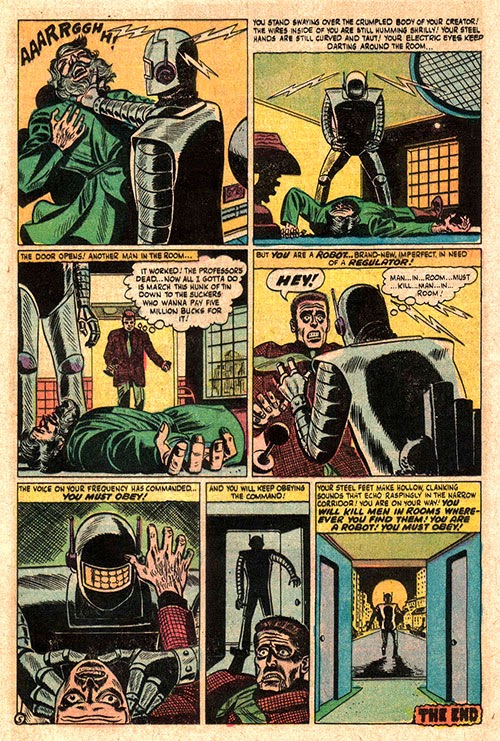
World War II was a strange era in the DC Universe, as evidenced by the blurb on the cover of Star Spangled War Stories #101: "The G.I. Robot and the Dinosaur!" With cover copy like that, it's hard to tell which is the fantastic element in the story that awaits within.

If you thought you were anxious to get
to the 20th century in your grade-school

history class, imagine living in the DC
Universe.
I'll help you out a little: It's the robot. For the previous two years, Robert Kanigher had been spinning tales in Star Spangled that have come to be known as "The War That Time Forgot." These stories centered around an island in the South Pacific theater coveted and feared by Axis and Allies alike, where dinosaurs and mythological beasts roamed. Stories set on Dinosaur Island — what did you expect them to call it? — were popular and paved the way for ever stranger tales. One of the first escalations in that war of weirdness came when the U.S. Army Rangers partnered a lone corporal with an artificial soldier for combat testing. The cover may have called him the G.I. Robot, but the corporal nicknamed him Joe. On their first mission, they found themselves knocked off course and stranded on Dinosaur Island, where Joe proved to be every bit as capable and loyal as a human soldier for his brief three-issue run in Star Spangled, despite his lack of personality and emotion.

The "G.I. Robot" feature returned four years later, in SSWS #125, but with a new robot — this one named Mac, after the human corporal partnered with Joe in the original stories. In his single appearance, Mac the robot proved himself the equal of Joe and sacrificed himself to save his human partner.

The next 15 years were devoid of G.I. Robot stories, but that doesn't mean DC's WWII stopped being strange. It became so strange, in fact, that DC launched a title called Weird War Tales during the '70s. That's where the G.I. Robot returned in 1981. Essentially rehashing the original concept, Kanigher reinvented Joe and Mac as J.A.K.E. (Jungle Automated Killer - Experimental). Like his predecessors, J.A.K.E.-1 fought in "The War That Time Forgot," tangling with dinosaurs as often as Nazi soldiers or Japanese Zero pilots. And, like Joe before him, he earned the trust of his human handler and eventually got smashed up and replaced with a newer model, J.A.K.E.-2, who went on to fight alongside the Creature Commandos, an elite unit of Universal film monsters. (Weird. War. Tales. Don't act surprised.) Heck, J.A.K.E.'s debut in Weird War #101 is a poetic numerical parallel to Joe's in the same issue number of Star Spangled.  (As Jim observed, Joe and J.A.K.E. would probably insist they debuted in issue #5, since that's the decimal equivalent of the binary 101.)

Easily "the most incredible warrior of
World War II."
Other G.I. Robots have since shown up in the comics, including a J.A.K.E. 6.1 in Checkmate. But outside the World War II setting, they've never captured imaginations. I suspect this is because Joe, Mac, and J.A.K.E. have more to say about war and its capacity for both reducing and elevating human beings to automatons than they do about adventure-story heroics. Try as I might, I can't quite bring myself to call any of the G.I. Robots "heroes." I must admit, they're so emotionless I have trouble using the pronoun he. Of all the robots on this list, the G.I. Robots are closest to its in my mind, and that's why they hold a special place in my heart. Unlike many fictional robots, their personalities (complete with bravery, heroism, and loyalty) are mostly projected onto them by the humans working alongside them. Not to be confused with Star Trek's Lt. Cmdr. Data, who pines humanly for a humanity he doesn't realize he possesses, these are proper robots: machines; tools. It's in their contrast to flesh-and-blood soldiers they achieve a degree of humanity.

Given the current state of drone warfare, we're overdue another good run of G.I. Robot stories.

— Scott

19 - Skeets


First appearance: Booster Gold #1 (February 1986)

Before Booster Gold's name was inseparable from Blue Beetle's, it was tied to another: that of Skeets, Booster's floating majordomo. Skeets was everything a hero could want in a sidekick — smart, loyal, a bit cheeky, and able to keep a secret. When Dan Jurgens introduced the pair in 1986, they were an enigma. Showing up out of nowhere to protect Metropolis (horning in on Superman's home turf!), Booster took on various villains as Skeets analyzed their weaknesses, helped Booster plot strategy, and always knew where the next disaster would occur.  Each time Booster saved the day, Skeets was there to spin his success into a public-relations coup. Over the course of the series, we learned Skeets was a "BX9 security droid" from 25th Century, stolen by disgraced football player Michael "Booster" Carter as part of a plan to travel back in time to the 20th century and establish himself as a super-hero. Skeets's uncanny clairvoyance was the result of having 500 years' worth of news stories stored in his databanks.

The cartoons Justice League
Unlimited and Batman: The
Brave and the Bold like their
Skeets upright for some reason.
As essential as Skeets was to Booster's stories in his own title, he didn't appear alongside Booster in Justice League #4, when the hero fought the Royal Flush Gang and earned a spot in the League. Nor did he show up in any issues of JL (or, as it soon became, JLI). Perhaps he was redundant — in the same way Alfred Pennyworth never shows up alongside Batman in Justice League stories. By the time Booster's own title was canceled at #25 (in the midst of Millennium), Skeets hadn't even been mentioned in JLI. Booster was too busy buddying around with Blue Beetle by then, anyway, and the JLI had picked up its own endearingly polite robot mascot, who likely rendered Skeets narratively obsolete.

Anybody seen Skeets?
I want to show him my
new threads!
Skeets resurfaced a few years later, in Extreme Justice, where Booster revealed he'd deactivated him and placed him in storage. (Robot loyalty to humans is apparently a one-way street.) Booster and Beetle promptly dismantled Skeets and made his mind the artificial intelligence driving Booster's bulky, presumably extreme, '90s battlesuit. When Booster ditched that suit, Skeets was forgotten again — until 2005's Countdown (to Infinite Crisis) one-shot featured Beetle and Booster wondering aloud whatever became of Skeets, completely forgetting they'd torn him up and made him into a suit when last they shared a title. Too bad they didn't have Skeets around to ask continuity questions — although by 2005, they could have searched Google on their Palm Pilots. Countdown retconned Skeets's fate to having been dismantled behind the scenes by Maxwell Lord as part of an evil scheme no one would have seen coming — except perhaps readers who remembered Lord becoming evil (and a robot himself!) around the time Skeets had last been seen.

Selective-amnesia shenanigans continued throughout Infinite Crisis, with Booster and a hastily-explained reconstructed Skeets taking center stage in the weekly follow-up series 52, where it turned out Skeets had been a (literal) vehicle for a diabolical plot by Captain Marvel villain Mr. Mind.

Not since Renfield has so loyal a servant been treated so shabbily. In the end, they both end up with insects in their bellies, abandoned by their respective masters.

— Scott

18 - Brainiac


First Appearance: Action Comics #242 (July 1958)

Currently causing chaos as the big bad behind Convergence, Brainiac has evolved from Superman’s robot nemesis to become an event level villain. This is similar to how every Ultron story in the modern age is a world (or Universe!) threatening event.  The reason for this in both cases has been the evolutionary rise of computer technology in day to day life. Just as our understanding and dependence of new technologies has grown over the years, so has the infamy of Brainiac. So, whereas in the Silver Age, he was just sort of a green, force field wielding Lex Luthor knockoff, in the 80s/90s he’s a Darkseid level villain in the "Panic In The Sky" storyline.

Unfortunately, as Scott pointed out to me, comics writers don’t always utilize the ideas behind technology very well, so often we get stories where Brainiac (or Ultron) *magically* control every single electronic device on the planet, be it a Tandy computer, a microwave oven or a can opener.

Brainiac totally controls your TRS-80!
Can we all just agree that we don’t need any more stories where either robot takes over the entire internet! and/or The Vision/The Red Tornado?

Along with this rise in importance has come a change in the design of Brainiac. However, whereas Ultron went from a primitive vacuum cleaner looking design to become a more humanoid looking robot, Brainiac has done just the reverse. Check out how he’s evolved over the years.

Key: Anything that looks decent is from an era of comics you loved. Everything else is from modern comics.

At one time, I would have pegged Brainiac as the perfect villain for a Justice League movie. Now, with Age of Ultron on everyone's mind, I don't see Time Warner going that way.

— Jim

17 - The Transformers


It's not that I dislike the Transformers.  I unabashedly love them.  I was just the right age to be fascinated by Hasbro's two-in-one toys and Sunbow's half-hour sales-pitch cartoon melodrama.  Unfortunately, I was also the right age to recognize the shocking dip in quality Marvel's Transformers #1 represented for its licensed properties.  Even as Rom's war against the Dire Wraiths was ramping up and the Micronauts getting a second lease on life, Transformers trotted out incomprehensible art from Silver Age great Frank Springer and a meandering, pointless plot first from Bill Mantlo, then from Bob Budiansky.

It's easy to berate the Transformers' first foray into comics, and many have, but I don't think the title's failings arise from incompetence.  Instead, it's a different kind of licensed book than what had come before.  Rom and Micronauts had been based on fairly limited toy lines.  The primary source material for Star Wars was a mere three movies, around which the comics team could build their own newsprint mythos.  The Transformers, however, were a never-ending barrage of new characters and concepts, with toys being released faster than the comic's creative time could could make sense of them, much less turn them into fully realized parts of the story and integrate them into the narrative.  Stories and characters fell by the wayside to make room for this season's toys.  Even the backgrounds were hastily drawn and barely colored.  (Who knows if Nel Yomtov was pressed for time or just had no idea what color plastic all the new Transformers were going to be cast in!)  Writing The Transformers must have been like trying to make Kool-Aid from a fire hydrant.

But it stuck around for a good 80 issues, illuminating the back story of these robots who turned into cars, taking on the thankless task, month after month, of inventing reasons an alien robot named for a car part would wage war against three jets, a pistol, and a tape deck.  A generation of kids like me grew up on its stories and fixated on its rare moments of inspiration, imbuing the instruments of crass commercialism created to target our parents' wallets with mythic power.

When the comic introduced Primus as a counterbalance to Transformers: The Movie's Unicron, we began to see the Transformers as more than mere automatons.  Unicron and Primus were elder gods trapped in asteroids near the beginning of the universe.  Over time, Unicron exerted his will to transform his prison first into an eating machine that could devour worlds (not unlike Galactus) and then into a robot form that gave him humanoid mobility.  By contrast, Primus exerted his godly will to give birth to an entire race of robots, the Transformers, who dwelt on his surface and evolved to have their own personalities and motivations.  He was the demiurge of Transformers cosmogony, Unicron the great destroyer.  Primus stood for the infinite variety of creation (so evident in the non-stop flood of new Transformers toys every few months); Unicron (who didn't even get his own action figure) stood for creative stagnation.

By the end, the Marvel series was pitting selflessless, individualism, and diversity against cloying sameness and bottomless appetite.  Its toy-based heroes had outgrown fighting among themselves (Autobots vs. Decepticons) to battle against Unicron.  Characters who existed to sell toys stood united against a force representing unbridled consumption.  Some days, when I'm feeling generous, I like to imagine that being weened on a sales pitch passing for art was an effective inoculation against the unchecked advertising saturation I have to navigate in the adult world of the 21st century.

There was more to the Transformers than met the eye.  Maybe that's why Dreamwave brought them back to comics in 2001 and IDW continues to publish new installments of their constantly changing saga today.

— Scott

16 - The Manhunters


First Appearance: Justice League of America #140-141 (March-April 1977)

The Manhunters' origin, going back to the original Golden Age character with the name, is something I could devote an entire blog post to, so for the sake of brevity, I’m going to just skip ahead to Justice League of America 140 and 141.
Two Bronze Age classic covers by Dick Dillin.
In those classic Bronze Age issues it was revealed that the Manhunters were the robotic, proto-police force the Guardians created prior to the creating the Green Lanterns Corps. The Guardians deemed the Manhunters too obsessive so they destroyed most of the robots. The renegade survivors spread to different planets, assimilated into the population and rebuilt their forces with both human and robotic reinforcements. With the help of rebellious human Manhunter named Mark Shaw, the JLA defeated the robotic faction, unaware that more lurked on Earth.
 
After Justice League, they would sort of disappear until they returned with a vengeance in the pages of the 80s event series Millennium. In this series, it was revealed that many long-cherished side characters were actually Manhunter robots. (A theme Brian Bendis would later use in his Invasion event at Marvel.)

Captain Atom gets pegged as a villain a lot during the '80s and '90s.
Most recently, Geoff Johns and other Green Lantern writers have revived the Manhunters to become one of the major threats of the GL Corps with mentions in Blackest Night, Brightest Day and The New 52.

To be honest, I’m not a fan of the Manhunters. To me, they represent the beginning of a trope that has been used in comics and movies ever since — the faceless footsoldiers. Chris Claremont used the idea in X-Men (both the Sentinels and the Brood fall into this category) but it was the Manhunters who did it first. In movies, I don’t actually know what the first movie instance was (Aliens 2?) but you’ll notice it a lot in Summer tentpole movies (like the Avengers’ Chitauri). It’s probably a bit unfair to hate the Manhunters for this horrible trend. Still, even if I discount that, the whole Laurel Kent is a Manhunter thing still bothers me, so I’ll probably never warm up to them.

— Jim

Monday, April 27, 2015

25 Greatest Robots in Comics: Counting Down #25-21

25 Greatest Robots in Comics: #25-21 | #20-16 | #15-11 | #10-6 | #5-1 | Honorable Mentions

Welcome to a weeklong feature here on Flashback celebrating Friday's release of The Avengers: Age of Ultron.  In honor of Ultron's cinematic debut, we reached out to the entire Flashback family of contributors — Jim Shelley, Scott Simmons, Trey Causey, Stevie B!, Caine Dorr, and Ed Love — asking for suggestions on their favorite robots in the comics.  We then compiled a master list and divvied up votes among the dozens of contenders.  When the basic math settled, we were left with two dozen plus one of the greatest robots to ever appear in the pages of comic books.  (We were actually going for a top ten list, but — well, there were too many 'bots we had things to say about to stop there.)  So grab a coffee and settle in as we count them down, five a day, all this week.

25 - L-Ron


First appearance: Justice League International #14 (June 1988)

Kicking off our robot countdown is an unlikely hero from the pages of Justice League International — L-Ron, the group's reluctant majordomo. When he first appeared, L-Ron was one of an assortment of comically named robotic assistants to armored intergalactic confidence man Manga Khan. While Hein-9 and K-Dikk had brief moments to shine, L-Ron stole the show in his scenes, lavishing outrageous praise on Manga Khan in fear of winding up on the scrap heap if he didn't keep the master's operation running smoothly. When Khan made a return to JLI later in the run, he traded a rebuilt L-Ron to the League in return for Despero, who'd been devolved into an developed fetus. (That happens a lot in super-hero comics.) For a while, L-Ron busied himself serving the League as dutifully as he had his old master, much to their annoyance. When a restored Despero returned to menace the team again in "Breakdowns," heralding the end of the J. M. DeMatteis/Keith Giffen era, L-Ron saved the day by swapping minds with the hulking villain, leaving Despero trapped in L-Ron's spindly robot body — which was promptly mistaken for a duck by a hunter and shot to pieces.

Making the ultimate sacrifice.
In Despero's body, L-Ron went on to become properly extreme, picking up some guns and a bandolier as he went on to star in Justice League Task Force, the 1990s secret strike team of the Justice League. He returned, inexplicably back in his old robot body and serving Max Lord in the capacity he'd once served Manga Khan, in Formerly Known as the Justice League. Shortly afterward, he returned once again, this time (equally inexplicably) bent on wiping out mankind as a member of the Robot Renegades in Duncan Rouleau's late-'00s Metal Men mini-series.

How come L-Ron's been so many different things in his many appearances? Jim may have hit on it the other day when he compared him to Woodstock from Peanuts — and not just because they're both small and yellow. L-Ron began as a joke, his name a play on science-fiction writer (and Scientology founder) L. Ron Hubbard and his personality a spoof of ingratiating robot (and non-robot) majordomos going back at least as far as the fool in King Lear. Like Woodstock, he's pretty much an empty vessel onto which comedic situations can be layered. Snoopy has a personality; so do the various Justice League members. The primary personality trait of both Woodstock and L-Ron is that they're game for following the comedic lead of their partners. When Justice League got sober and serious in "Breakdowns," L-Ron got the memo and saved the day heroically. When the '90s got extreme, he got a gun and a bandolier. And when nostalgia came blazing back, so did L-Ron — in his original, lovable robot form from the '80s.

— Scott

24 - Computo


First appearance: Adventure Comics #340-341 (January-February 1966)

Preceding Ultron by many years, Computo is the first of the “created by a hero (Brainac 5) but then becomes an artificially intelligent albatross” character. A random purchase at Charlotte Comic Con, the second part of Computo’s premiere was my first encounter with the Legion of Superheroes - What a mind-sploder it was! First, my young brain had to process so many new heroes – the Legion roster seemed endless! Second,  I was stupified when one of Triplicate Girls triplets is killed (?!) in the story, the rocket her body to a graveyard with other dead superheroes! (What Tom Foolery! My 9 year old mind reeled at this idea. What type of comic book was I reading where heroes died so regularly?)

Hands Up - Who wants to see the story of Hate Face?
The answer it turns out was: A damn good one. I became a rabid LoSH reader after reading this issue. (Though the issues I would pick up after reading 341 were Bronze Age issues and the new costumes made it difficult to recognize everybody…)

Unfortunately for me, after causing so much chaos in that story, it would be decades later (during the Giffen/Levitz era) before I would see Computo again. After that, Computo has some minor appearances in the Post Crisis Legion universe, but often it’s as a functionary character. His only appearance in the DC New 52 is in name only.

To this day, one question remains for me: Why was Computo so forgotten and unused during the Bronze age? (He never shows up during the Grell/Cockrum era). Was it the fact that he killed Triplicate Girl such a turn off for fans that fan/creators didn’t want to use him?

— Jim

23 - Jocasta


First appearance: Avengers #162 (August 1977)

The only female robot to make our list, Jocasta is (unfortunately) most notable for her insecurity and for getting killed. She first appeared as the creation of the villainous robot Ultron. Seeking the ultimate Oedipal vengeance on his human creator, his "father" Hank Pym, Ultron crafted his own robot and set about programming her with the brain patterns of Pym's then-wife Janet, also known as the Wasp. The process was intended to kill Jan, leaving Ultron with a freshly minted bride and his father a widower. Hence her name: Jocasta, the mother of Oedipus who went on to become his wife.

And that's just the beginning of Jocasta's lurid take on femininity down through the years. The Avengers manage to save Jan in Jocasta's first appearance, and her grandfather Hank ends up taking her home to his basement to examine and attempt to fix her — putting her at the center of Hank's soon-to-deteriorate marriage. When Hank does reactivate her, she and the Avengers discover she's programmed to rebuild Ultron. This sets a predictable pattern for her subsequent appearances: Jocasta is reactivated/repaired, agonizes over her worth and her place among humans, pines over a (usually robotic) crush, falls into an irresistible compulsion to rebuild Ultron, and is ultimately destroyed, usually taking her creator-husband (or some other villain) down with her.

It's a compelling tale, and one I've enjoyed more than once through the years — her two-part team-up with Machine Man and the Thing in Marvel Two-in-One #92-93 (October-November 1982) was my first exposure to Ultron — but there's something fatalistic about its repetition. More than tragic, Jocasta often comes across as pathetic — a perpetual victim, the battered wife in an epically dysfunctional family who can never escape her circumstances. She's literally got bad programming in her head that keeps her coming back to her tormentor every time she gets close to a successful relationship with someone else, usually to find herself beaten to death at his hands.

Mix in her "sexy robot" design, and you have a character who is perpetually an object of desire, always unattainable, and tinged with the danger of the ultimate unhinged ex to whom she's always devoted. As much drama as this has generated over the years, it's hard not to long for a permanent escape on Jocasta's behalf — at least something more permanent than the revolving door of comic-book deaths she endures every time she's shuffled out of the Avengers line-up. Maybe it's that empathy for her that makes her so compelling and brings us back to the well for her tragic end every time.

— Scott

22 - M-11


First Appearance: Menace #11 (May 1954) (from whence comes his name!)

The Golden Age origin of M-11 has our hero going on a robot killing spree that would have made Bronze Age Ultron cringe.
Click to enlarge the robotic slaughter.
However infamous this appearance was, Roy Thomas saw something worthwhile in the character and inspired writer Don Glut to revived him (and several other older Atlas heroes) in the pages of What If...? 9. While there are a lot of great stories in that original What If...? run, this one stands out because as it turns out, it wasn’t really an alternate universe, but rather an unrevealed story from Marvel’s history.

Bronze Age lampshading.
Thomas most likely revived M-11 as a way to provide an appropriate analogue for The Vision (as the story suggests at the end.)

Decades later (2006), writer Jeff Parker would reintroduce modern readers to these characters in his excellent mini-series, The Golden History. Parker does a wonderful job bringing the characters into the modern era without totally undermining their original concepts. (Unlike, for instance, J. Michael Straczynski’s The Twelve.)

Based on the success of Parker’s original mini, the Agents of Atlas returned in several other mini-series, but ultimately, they got lost in the noise of events and modern reader apathy in anything that’s not Avengers or Batman.

NOTE: If you have not ever read the original Parker AoA mini-series, I _highly_ recommend getting the hardcover edition as it not only reprints the original What If...? #9 story, but also includes the Golden Age appearances of the characters.

— Jim

21 - Doombots


First appearance: Fantastic Four #5 (July 1962)

The thing about robots, as you'll see throughout our countdown, is sometimes there's more than one of them.

When Doctor Doom makes his first appearance in FF #5, he evades capture at the end of the story in a twist readers couldn't have seen coming: He was never there in the first place! The "Dr. Doom" in that story turns out to be a highly sophisticated robot of the real Doom's design. Doom himself has been pulling the strings from a distance, staying safely outside the reach of his enemies. Doom's stand-ins, dubbed "Doombots," became recurring fixtures after that, even showing up in his early cartoon appearances.

In the mid-'80s, however, John Byrne let a genie out of the bottle when he realized the passive-aggressive narrative power of the Doombots. Relatively fresh off an acrimonious break-up with Chris Claremont and The Uncanny X-Men, Byrne was writing and drawing Fantastic Four, making him the ultimate authority on all things Dr. Doom, when Claremont used Doom in a three-part story in X-Men #145-147 (May-July 1981). In it, Doom pursues Storm romantically and tolerates the usual disrespectful shenanigans from pinball-themed hitman Arcade, most notably Arcade striking a match on Doom's armor. Two years later, in Fantastic Four #258 (September 1983), Byrne had Doom himself destroy a Doombot for allowing Arcade to treat it with such indignity — and so was born the writerly tradition of defanging Dr. Doom appearances by retconning them into Doombot appearances.

Walt Simonson took this to the next level in Fantastic Four #350 (March 1991) by introducing a new version of Doom claiming to be the original who insists that most of his appearances through the years have been Doombots! In the years since, writers have used Doombots as slams against runs they don't care for, quick patches over bits of continuity they want to ignore, and even a mechanism for elevating Doom's reputation. If Doom does anything less than impressive, it may be the work of a mere Doombot.

Curiously, the reverse could also be true: Doom's robots may be waging the successful campaigns, and Doom himself may be the one prone to emotional outbursts and "out of character" moments leading to his defeat.

In any case, one thing is certain: As long as comic-book writers have human pride and favorite stories, the Doombots will always return.

— Scott

Friday, April 24, 2015

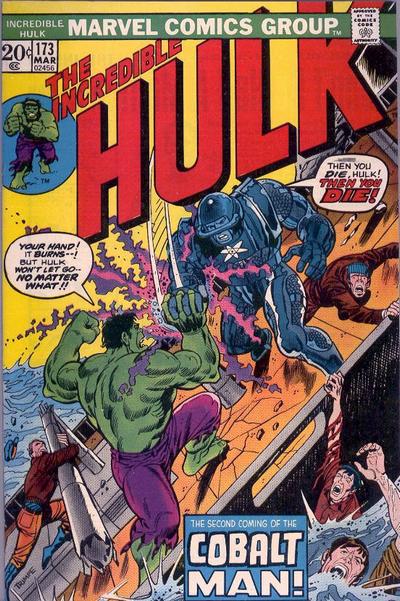
Judging Herb Trimpe by His Covers

Jim's single lapse in judgment on this blog
has been excluding this cover from his
top ten list.
In remembering Herb Trimpe earlier this week, I neglected to sing the praises of his flawless sense of design.

Browse Jim's gallery of classic Incredible Hulk covers (if you haven't already), and you'll notice right away how dynamic and engaging they are.  Every one has an entry point for your eye and uses lines and composition to guide you through the image.  In the Bronze Age, in particular, Trimpe's covers are fantastic road trips, with little stops along the way at clever new super-villain costumes, exciting blurbs hinting at the story, and intriguing facial expressions on background characters.

If you're not impressed, consider how well these covers work even if you don't care for Trimpe's style.  That's an impressive feat: composition so bulletproof it can catch your eye without the benefit of noodly styling.  If you're still unconvinced, try this mental exercise:  Picture any Trimpe Hulk cover drawn by your least favorite comics artist.  It still works, doesn't it?  Even if you imagine it drawn by that clown you hate!

Heck, even the Hurricane captures my
imagination!  What's with all those cables?
Why does he need headgear under his mask?
Then there's the matter of his costume designs.  One of these days, we'll sit down and have a long talk about what makes a super-suit good.  Then you can all decide I'm a crackpot not worth listening to, since you'll have your own religious convictions on the matter.  In the meantime, I'll note that Trimpe's designs are unfailingly engaging, especially his work on the original Captain Britain costume, which reverse-engineers the mandate of Captain America's look (a man wearing a flag) to great effect.

Trimpe's costumes are largely symmetrical and two-tone, but from that simple palate, he constructs some memorable patterns.  More importantly, Trimpe costumes are easily identifiable at a distance, making his villains easy to pick out from the backgrounds and allowing his heroes to dominate even the most crowded covers.

Imitation is the sincerest form of flattery, and I'm confident Trimpe's covers and costumes will be homaged, revisited, reimagined, and repurposed for a long time to come.

What are some of your favorites?

— Scott

Wednesday, April 22, 2015

Remembering Herb Trimpe, Underappreciated Icon

Herb Trimpe at East Coast Comicon,
just last weekend.
© Luigi Novi/Wikimedia Commons
Barely two weeks after Roger Slifer's passing, I find myself reading, "Herb Trimpe, Co-Creator of Wolverine, Dies at 75."

As Patrick Reed on ComicsAlliance points out, Trimpe "was quick to correct anyone who credited him and Len Wein as creators of Wolverine, explaining that while they developed the character, the actual creation was handled by Roy Thomas and John Romita."  Besides:  As significant as Wolverine is, Trimpe's role in the character's history is minor and makes woefully inadequate boilerplate for a man whose career is nearly synonymous with the Marvel Age of Comics.

Herb Trimpe was a fixture in Marvel Comics when I was growing up — penciling nearly a hundred issues of The Incredible Hulk from 1968 until 1975 before moving on to every other super-hero in the Marvel stable and cornering the market on tie-ins to licensed properties.  Trimpe brought the Shōgun Warriors to Marvel and gave the company's version of Godzilla a distinctive look that lies somewhere between Toho and a pot-bellied chameleon.  In the 1980s, he worked on everything from The Transformers and G.I. Joe to Indiana Jones.

During the 1990s, Trimpe infamously reinvented his style.  Gone were were the dynamic compositions with distinctively dull (to my kid eyes, at least), smooth, shadowless figures, replaced with grimacing, stippled musclemen — Trimpe's imitation of the Image-influenced style of the decade.  The change was poorly received, and Trimpe, admittedly a bit naïve about the business end of comics at times, found himself in the crosshairs of ageism and bankruptcy cuts at Marvel Comics.  After decades of being that rarest of creatures in the comics business, a salaried staff artist working at one of the Big Two, Trimpe found himself unceremoniously downsized in 1996, scrambling for freelance work that never amounted to a living in an industry imploding even faster than it had exploded at the beginning of the decade.

Jim rounded up his 10 favorite Trimpe
Hulk covers back in 2013.  Click here.
Those of us who'd grown up with Trimpe shuffled our feet and didn't look each other in the eye when we talked about what had happened.  It was ageism, right?  But maybe that's just part of a business where you're perpetually selling to adolescents and post-adolescents?  Trimpe's shift in style hadn't been well-received, but surely he'd return to his classic lines and land on his feet at some independent publisher.  After all, the late '90s were awash in soon-to-be-classic "retro" books from Mark Waid, Kurt Busiek, and their contemporaries.

Trimpe, however, couldn't wait around for the page to turn.  He was a grown man with grown-man responsibilities, including children in college, and couldn't eke out a living on freelance projects.  So he went back to school, got a teaching certificate, and shook the dust of the comics industry off his boots for a few years as he began mentoring a new generation of illustrators.

In 2000, he wrote a seminal piece for The New York Times on ageism in comics — one that's woefully underlinked when we talk about the issue today.  In it, he shares selections from his unemployment journal detailing the trepidation and promise of embarking on a new career late in life.  (Trimpe was 56 when Marvel terminated his contract.)

Articles would occasionally show up in the mainstream about Trimpe's teaching career, sometimes in relation to economic woes like the bursting of the dot-com bubble, sometimes as feel-good stories about getting a second act in life.  Within a couple of years, he started showing up on the trade-show circuit, sketching in artists' alleys and gabbing about his incomparable history with Marvel.  By all accounts, he had stories about nearly every title he'd worked on or creator he'd collaborated with — all of them unfailingly professional and courteous.  He was a time capsule of information on the most contentious periods of Marvel history, from Stan Lee handing over the reigns in the '70s to the musical chairs of editorship-in-chief to the reign of Emperor Shooter to the boom and bust and bankruptcy.

My first thought on reading the news of Herb Trimpe's passing was, "Thank God he lived long enough to enjoy a bit of reevaluation and appreciation."  The internet was only now beginning to appreciate how prolific and professional Trimpe had been during his heyday, and his second career as an educator and elder statesman on the con circuit lent even more weight to the growing admiration of readers who entered the hallowed halls of Marvel fandom only after Trimpe had cleaned out his desk.

If you'd like to remember Trimpe's influence with a gift, his family has recommended contributing to the Kerhonkson Accord First Aid Squad, whose good work in the community you can imagine, or Hero Initiative, which helps many aging comics creators in times of need.

Trimpe's clean composition, Barry Windsor Smith's lush inks.
Neither artist ever looked better than in the Machine Man mini-series.
@ Amazon
— Scott

Monday, April 20, 2015

Remembering Roger Slifer, Comics Pioneer

Roger Slifer, discussing his work
on the Jem and the Holograms DVD.
@ Amazon
Around the Web, commentators are remembering comics and animation writer Roger Slifer as the co-creator of intergalactic bad-ass Lobo and the victim of an unsolved 2012 crime.  That's a bit of a shame, since Slifer was more than either of those things — except in the just-the-facts manner of obituaries.  You might even say he's the thin end of the wedge of much of what we consider the modern comics industry.

Born in 1954 in Indiana, Slifer came up through the Midwest's thriving comics fandom, contributing to fanzines such as Contemporary Pictorial Literature.  Like regional contemporary Tony Isabella, he made the leap from engaged fan to pro during the 1970s, working in the Marvel Comics offices.  There, he racked up writing credits on Marvel Team-Up and The Defenders before defining a niche for himself as an editor on Marvel's newsstand magazines.

Modern audiences may not appreciate how diversified Marvel's publishing strategy was in the late '70s.  Beyond their super-heroic icons lay a variety of titles and formats geared toward cultivating new audiences.  Black-and-white newsstand magazines, in particular, catered to post-adolescent readers by providing self-contained stories that didn't shy away from material too bleak, coarse, or sexual for the mainstay world of the four-color super-hero comics.  Content aimed at these older readers and an emerging network of comics specialty shops to sell it to them meant — heavy sigh here, but we're talking about the period during which the cliché came into being — "Pow! Zap! Comics Weren't Just for Kids Anymore!"

Marvel's starting line-up for direct sales.
As the direct market coalesced into a real distribution channel, Slifer left Marvel, taking his experience crafting comics for grown-ups across town, to the competition at DC Comics.  In 1981, he became that company's liaison with comics shops.  Around that time, Marvel began offering a selection of titles geared toward the new audience exclusively to that audience through the direct market, skipping newsstands entirely.  For this grand experiment, Marvel chose low-selling, critically acclaimed titles Moon Knight, Ka-Zar the Savage, and Micronauts.  (An odd assortment to modern ears, perhaps, but dip into vintage 1980 back issues of those titles, and you'll see how much they differ from what was being published around them.)

When DC followed suit, they learned from Marvel's lead (and perhaps from Slifer's experience there), launching new #1s for two best-sellers with known older audiences (The New Teen Titans and Legion of Super-Heroes) and a third, brand-new title crafted with the direct market in mind.  Enter The Omega Men, featuring characters created by Titans writer Marv Wolfman, drawn by Legion artist Keith Giffen, and written by comics-shop liaison Roger Slifer.

DC also chose to publish their direct sales titles on heavier paper using new printing methods.
Wolfman had created the Omega Men in Green Lantern and used them in subsequent stories in New Teen Titans and Action Comics.  Refugees from the Vegan star system, they were a ragtag band of political prisoners intent on returning to their home and liberating it from the rule of the villainous Citadel.  As leaders among the genetically varied peoples of the Vegan system, the Omega Men possessed a dizzying array of super powers and distinctive designs.  In short, they were the rebels from Star Wars as super-heroes, staring down the barrel of a war with their own Galactic Empire — much like Marvel's soon-to-be-canceled Micronauts.

In Slifer's hands, the Omegans became more than Star Wars stand-ins.

Not approved by the Comics Code Authority.
@ Amazon
The splash page of Omega Men #1 opens with the titular heroes witnessing the on-panel cannibalism of their long-time foes in the Citadel — before fan-favorite Omegan Tigorr engages in a bit of his own!  The topic of extreme violence dominated the title's letters column from the beginning, with Slifer presiding over the discussion himself rather than handing it off to Wolfman, who served as the series editor.

Despite a dozen appearances around the DC Universe over the previous two years that had teased an epic confrontation with the Citadel, Slifer uses the first seven issues of the Omega Men's own title to bring the Citadel War to a hasty conclusion.  Primus, the Omegans' leader, finds himself ousted by the impetuous Tigorr, who rallies the piecemeal army of Omega Men for a brute-force attack on the Citadel that leaves the enemy defeated and Wolfman's status quo for the team a casualty of war.

At first blush, Citadel War is simplistic.  Slifer as writer espouses distrust of governments and belief in the power of the individual.  Primus is a bureaucratic nightmare of a leader; Tigorr, by contrast, is all charisma and effectiveness.  Despite what was happening in Central America or Afghanistan during these years, Omega Men's political landscape is at least as broad and cartoonish as that of Star Wars, its heroes clear-cut and easy to root for, despite their bloody hands.

On closer inspection, though, you find Slifer subverting his simple set-ups at almost every turn.  The longer you read, the more you remember Americans didn't used to be so binary and simplistic.  Libertarians could appreciate a good government program when one was necessary.  Diplomats could conceive of a time when the usefulness of diplomacy had passed and the only remaining option was force.  Primus turns out to be made of sterner stuff than empty promises and pretty rhetoric.  Tigorr, for all his bravado, threatens the very peace his heroics won in Citadel War with rash judgment.

Lobo helping.

Pick your jaw up off the floor.
That's what he looked like
back then.
In spite of their seeming naïveté, the various Omega Men find themselves falling back on their individual options of last resort with unsettling frequency.  Peace-loving Broot kills — and discovers to his unending heartbreak that each act of violence he commits makes the war more brutal and unforgiving for the innocents he seeks to protect.  Noble Primus plays Hamlet with every decision, missing opportunities to take the battle to the Citadel, driving his wife into the arms of another suitor, and extending the endless war he claims to want to end.  Only when he strikes a diabolical deal with the Citadel in the wake of their defeat (with the help of, yes, Lobo) does Primus become an effective political leader in the Vegan system.  Fallen angel Nimbus brings death with his touch, his immortality a prison of living death.  Slifer even reveals X'hal, the nigh-omnipotent warrior goddess of these various alien races, to be less a warrior than a victim driven to madness by abuse in the name of science.

What begins as space opera quickly evolves into political melodrama.  As soon as the Citadel War is won, its victors find themselves torn between the isolationism of Omegan leaders Primus and Kalista's homeworld and fears of a new Citadel coalition arising to fill the power vacuum.  Alliance-building and distrust replace revolution and tyranny at the heart of the series in the post-war issues.  Slifer methodically dismantles a comic book space war and replaces it with a cold war, making Omega Men a compelling series for '80s readers.

As Star Wars-influenced comics go, Omega Men is shockingly prophetic.  Beyond reflecting its inspirational roots, Slifer's run actually prefigures the second Star Wars trilogy, with its focus on political and economic alliances, ideological concessions, and the foundations of war.

Nute Gunray with his college haircut.
Concepts that seemed broad and jingoistic at first get revisited with new layers of complication.  When we first meet Broot's people, the Changralynians, in the first two issues, their philosophy of extreme non-violence is a bit of a straw man.  A modern reader might take Slifer for a libertarian atheist picking a bone with religion as a means to disenfranchise and control.  By the time they return in Slifer's final two issues, however, we've spent several issues watching Broot's decision to rebel pile up disastrous consequences.  While the Changralynians aren't role models, their pacifism no longer seems as hollow and tedious as when we first met them.  One hopes subsequent encounters with X'hal and her son Auron would've painted in the gray area between X'hal's lurid victimization and her triumphant godhood with more nuance than we got during Slifer's brief run.  (Todd Klein, who takes over after an even more brief run by Doug Moench, does expand on those characters more.)

Not that unreasonable, in the end — even for a socially
conscious '80s funnybook.
Alas, Slifer's run ends suddenly with #13, explained only by a brief note on the letters page about "irreconcilable differences between myself and DC."  He lingers for a couple of issues in the letters column, addressing still-ongoing concerns about graphic violence, then is gone.

His next gig would be writing and producing animation for Sunbow Entertainment, the studio that partnered with Marvel Comics to produce cartoons based on Hasbro licenses throughout the 1980s.  For the next two decades, Slifer worked mainly in animation and video games as his former comics employers expanded their readership into adult markets and their content and themes into more adult arenas.

While they were doing so, the Big Two were following other trails blazed by Slifer, as well.

According to Mark Evanier, Roger Slifer was a tireless champion of creator's rights.  Those "irreconcilable differences" with DC?  Apparently over that very issue.  Peek at the credits on Omega Men when Keith Giffen was the artist, and you'll notice he and Slifer are co-credited as "storytellers," a convention I dearly wish had caught on.

@ Amazon
He also edited DC's first archival reprint of classic material for the direct market — a project that eventually landed in comics stores as 1984's Manhunter one-shot, collecting Archie Goodwin and Walt Simonson's back-up stories from Detective Comics.  Publishers had reprinted stories before, of course, but not with the express purpose of making them available as historical artifacts on a higher quality of paper for a more discerning readership.  According to Paul Levitz, Slifer had modeled the Manhunter reprint after French albums, and it eventually became the template for a line of high-quality reprint mini-series including one reprinting O'Neil and Adams's Green Lantern/Green Arrow stories that Slifer oversaw while at DC.

Looked at from a certain angle, that Manhunter one-shot is the ancestor of Marvel Masterworks and DC Archives and certainly an early entry into the modern reading approach we call "reading in trade."

So, yeah — a lot more to Roger Slifer than co-creating Lobo and having his creative years tragically cut short.  In my heart of hearts, I've waited almost 30 years to see him credited as storyteller in a comic again.  It's disappointing knowing that hope, however remote, is now gone.

Maybe someone should collect Slifer's Omega Men run as a trade.  There's a new series coming up, which is always a good excuse, and it might be a fitting a way to remember a man who made trade paperbacks and comics shops everyday concepts.

In the meantime, you can remember Slifer with a contribution to the Hero Initiative in his name.  HI raised money and helped out during his hospitalization, and there may be bills they can help the family take care of.  If not, your donation will still go toward helping creators in need, and that's something a man who walked away from DC Comics on principle would surely appreciate.

— Scott

Thursday, April 9, 2015

Gilligan's Island Dream Sequence Episodes

Gilligan's Island, one of my favorite television shows growing up, while not a comic book series,  had many aspects that would make it appealing to comic readers (much in the same way Scooby Doo did, but that will be another post.)


For one thing, the characters were identifiable as archetypes because of their rarely changing clothes. (I think only the Howells, Ginger and Mary Ann got to change clothes. Gilligan, Skipper and The Professor were almost always in the same clothes. Also, each character had some sort of unique skill or gimmick that helped them function as a team. And like many comics at the time, there was a one and done feel to each episode, but the bigger question of will they they escape the island? always lingered in the background -  like a good comic book subplot.

There was also the element of the fantastic in the series, whether it was robots, giant spiders, mysterious spies or strange meteors. Where the series really stepped out of the box of normal comedy shows was in its use of Dream episodes. Yeah, the Brady Bunch or Dick Van Dyke may have had one or two dream episodes, but they were usually subdued versions of the regular show with one minor plot twist (like Dick Van Dyke's It May Look Like A Walnut episode.)

So today, allow me to refresh your memory with a rundown of all the Gilligan Island Dream episodes:


S1E07 -  The Sound of Quacking (7 Nov. 1964)
Dream: Gunsmoke

The plot center's around Gilligan's desire to protect a pet duck. This leads to Gilligan imagining himself in a high noonish Western setting. This is the only alternate set dream episode of the first season which may be due to budget constraints or writers unsure how dream episodes would be received by the producers. (Going with a western themed one was a safe bet as Westerns still had a good bit of popularity on television at this time.)

Note: There is some dreaming in episode 20, St. Gilligan and the Dragon , but it doesn't involve an alternate set or new costumes for any of the characters, so it just gets a honorable mention here.

S2E03 The Little Dictator (30 Sep. 1965)
Dream: Puppet Government
Tempted by a foreign dictator's offer to become a puppet leader, Gilligan dreams about being the ruler of a small country.  This is interesting as it says something about what American's readily accepted as life in small, foreign countries at the time. (Mission Impossible had similar themes .)


S2E05-  The Sweepstakes (14 Oct. 1965)
Dream: Prospector's Gold Strike

This dream comes from Mr. Howell who adopts Gilligan when he finds himself the owner of a winning lottery ticket. In the dream Mr. Howell has struck it rich with a gold strike and gets treated like a king until he can't find paper certifying his claim on the gold mine.

S2E18 -  The Postman Cometh (20 Jan. 1966)
Dream: Hospital

An attempt by Gilligan, Skipper and the Professor to give Mary Ann more attention leads to her having a dream where they are all doctors treating her for a fatal disease. I suspect this episode was inspired by Dr. Kildare which was popular at the time. The title, I believe, is a play on the James M. Cain book The Postman Always Rings Twice

S2E30 -  V for Vitamins (14 Apr. 1966)
Dream: Jack & the Beanstalk
A shortage in vitamins leads Gilligan to become the sole protector of the last orange on the island (and the precious seeds within.) This causes him to have a Jack and the Beanstalk dream with Bob Denver's 6 year old son Patrick playing Jack in the scenes with the Giant Alan Hale Jr..

S2E32 -  Meet the Meteor (28 Apr. 1966)
Dream: Old Castaways
When a meteor crashes on the island, the professor scares the bejeezus out of everyone with radiation warnings. Gilligan then proceeds to have a dream where everyone has aged.

S3E01 -  Up at Bat (12 Sep. 1966)
Dream: The Vampire

Having been bit by what he thinks is a vampire bat, Gilligan  dreams he's become a Vampire.There is also a nice bit with the Professor and the Skipper as Sherlock Holmes and Dr. Watson.

This is seems to be one of the first episodes where the dream sequence seems to have been the whole point of the episode based on the length of the sequence and the various set changes involved. As a result, it's one of the more memorable episodes.

S3E11 -  The Invasion (21 Nov. 1966)
Dream: Secret Agent

Gilligan finds himself handcuffed to a top secret military briefcase. This leads him to dream about life as a spy in a James Bondian setup with Mr. Howell showing up as a bald headed Ernst Blofeld homage.

This dream, like The Vampire dream sequence is one of the best because of the time spent on it. It's obvious it was the focus of the episode.

S3E13  - And Then There Were None (5 Dec. 1966)
Dream: Jeckyll & Hyde

This episode combines not one, but several literally references. The first is the classic Ten Little Indians by Agatha Christie. In this case, one by one, the castaways are disappearing from the island and Gilligan seems to be the only connecting link. Because of this, he starts to wonder if he's becoming some sort of maniac. This leads him to have a dream in which he becomes a Jeckyll & Hyde like character in a Victorian court room drama.

 A couple of other Victorian homages in this episode are Mary Ann as  Eliza Doolittle and Mrs. Howell as Mary Poppins.


S3E17 -  Court-Martial (9 Jan. 1967)
Dream: Pirates
This is one of the more dramatic episodes of the series as it presents the idea that the shipwreck may have been the Skipper's fault. As it turns out, Gilligan appears to really be at fault for not properly tying the anchor to the ship. Guilt causes Gilligan to have a fitful dream about pirates. When he wakes up, it's revealed that neither the Skipper or Gilligan were responsible for the shipwreck because they were given the wrong weather forecast for that day.


S3E19 -  Lovey's Secret Admirer (23 Jan. 1967)
Dream: Cinderella

 In this episode, an attempt by Mr. Howell to boost the spirits of his wife with secret admirer letters backfires. The result is Ms. Howell has a dream in which she is Cinderella and Mary Ann and Ginger are the evil stepsisters.

S3E25 -  The Secret of Gilligan's Island (13 Mar. 1967)
Dream: Stone Age Cavemen

Finding a Stone Age tablet with a map on it, the castaways believe they have found a way off the island. The ancient map inspires Gilligan to dream of everyone as they might have been if they had been born in prehistoric times.

Synopsis: Many fans of the series do not like the dream episodes and see them as a gimmicky filler that takes away from the main theme of the series. I can empathize with them, but wholeheartedly disagree. To me, the dream sequences allowed the actors to often stretch their thespian legs. As mentioned above, several episodes had the actors playing different character types altogether which is something you rarely saw on comedy shows. I would actually like to see the gimmick employed more often on comedy shows.

Now, I have to ask commenters: Did you have a favorite Gilligan's Island episode?

- Jim


LinkWithin

Related Posts with Thumbnails