
All week, we've sung the body electric in anticipation of today's U.S. release of Avengers: Age of Ultron. Now, at last, it's time to see whom the Flashback Universe contributors have selected the five greatest robots in comics.
5 - Vision

First appearance: Avengers #57 (1969)
Oh Vision, you started out so cool and simple. You were built from the body of the original Human Torch and your mind was based off of the recorded brainwaves of Wonder Man. (Okay, maybe simple is a stretch, but it was sort of cool.)

However, over the years, your origin has become such a jumbled mess of retcons and revamps that an entire mini-series (Avengers Forever) had to be written to explain who you are. And while Avengers Forever contains some very fine parsing of the Marvel Universe and history by Kurt Busiek, its ultimate resolution for the Vision’s origins is less than satisfying. The quick version is this:
Immortus, the Absolute Master of Time, used the Forever Crystal to create a split in the timestream which allowed there to be TWO Human Torch androids in Professor Horton’s lab. One that Ultron took to build the Vision and one that was buried (and eventually revived by the West Coast Avengers.)As explanations that try to meld two conflicting origins go, I would put this one in the Warm Milkshake category. It’s not insulting, but it won’t make anyone very happy either.
Honestly, fictional history aside, I’m a bit more interested in the Red Tornado/Vision connection. As well covered by the site ComicCoverage.typepad.com, there are a number of similarities between the two that make one wonder if they have a common inspiration.

Gardner Fox created the Red Tornado. Fox was no stranger to Android characters (having created Amazo years before) but one wonders what inspired him to include such a character in the JSA?
Over at Marvel, Roy Thomas wanted to revive the Golden Age Vision into the Avengers but Stan Lee wanted the new Avenger to be an android. What made Stan so adamant about adding an android character?
Going by the date (1968) here are some possible candidates:
Androids on Star Trek
- Dr Roger Korby, Andrea, Dr Brown, Ruk and the Kirk android in the episode "What Are Little Girls Made Of?" (1966) [This is my high favorite as the android characters struggle with emotions in this episode.]
- The Norman, Alice, Herman, Barbara, Maizie, Annabelle and Trudy series androids and the Stella Mudd androids in the episode "I, Mudd" (1967)
- Verda, a gynoid in the episodes "The Android Machine" (1966) and "Revolt of the Androids" (1967)
- Raddion, a male android in the episode "The Dream Monster" (1966)
- The IDAK Super Androids in the episode "Revolt of the Androids" (1967)
- The Industro Mini Robots in the episode "The Mechanical Men" (1967)
- The Xenian Androids in the episode "Kidnapped in Space" (1967)

I picked these shows as the robotic characters were specifically called Androids on the show AND they both were somewhat popular at the time. The term android had been around for a long time, but I feel some specific pop culture reference got Fox and Lee thinking on the same frequency at the same time. Another possibility, given the emphasis on cold, emotionless personality in both characters, is Spock as ComicsBeat.com suggests. That would point the finger at Star Trek as the inspiration for the character type.
If anyone has any further insights to this mystery, please feel free to chime in in the comments section down below!
— Jim
4 - Astro Boy

First appearance: Shonen Kobunsha Magazine (April 1952)
Astro Boy was originally a Japanese manga series created by Osamu Tezuka from 1952 to 1968. In 1963, the manga was adapted as an animated television series. It was this series that, when imported by NBC in 1963 brought the character to the attention of American fans.
In the series, Astro Boy is created by Doctor Tenma (or Dr. Astor Boyton in the English version), sold to a circus then rescued by the head of Ministry of Science by kindly Professor Ochanomizu. At the MoS, Astro Boy’s full superpowers are discovered: Super-strength, flight, laser eyes, super hearing, high IQ and a retractable machine gun. He uses his powers to fight crime and evil human hating robots.

As to the series legacy, it’s hard not to see a some of Astro Boy’s influence in Big Hero Six.
— Jim
3 - Silver Age Robotman

First appearance: My Greatest Adventure #80 (June 1963)


Which brings us to the best reason of all not to call Cliff "Robotman": It's a bit of a slur. And that's saying something when you consider the Doom Patrol routinely describe themselves as "freaks."

Despite his internal struggles to hold onto an identity without a body to anchor it (or perhaps because of it), Cliff Steele remains one of the best-liked characters in the DC Universe, both in-story and by readers. We can attribute much of that to his everyman qualities. He's often the viewpoint character for the strange and confusing challenges the Doom Patrol face, and his lack of a fixed physical identity may make it easier for readers to imagine themselves in his place in the story. Though he was once white and male (and still is, in many ways), the physical elements that defined him thus are long gone, leaving behind a robotic shell any of us can project ourselves into as readers. Without skin, without sex organs, would those parts of our identity even matter any more? They certainly matter less to Cliff Steele (however much that may trouble him), and that allows us to imagine ourselves in his place, to identify with his unimaginable tragedy.
— Scott
2 - Golden Age Robotman

First appearance: Star Spangled Comics #7 (April 1942)
There have been many heroes to bear the name Robotman, but the first was Robert Crane, a character created by Jerry Siegel and Leo Nowak in 1942. While working with Chuck Grayson, his assistant, Crane is attacked and killed by bandits trying to steal his inventions. In an attempt to save Crane’s life, Chuck transplanted Crane’s brain into the body of a new robotic prototype they were working on. This surgery was successful, and Crane was able to live on in the body he called Robotman.

First, Robotman isn’t technically a robot. He’s a cyborg. However, that term wasn’t coined until 1960 by real life scientists Manfred Clynes and Nathan S. Kline.
Second, Robotman was not the first cyborg character in comics. He is predated by the Centaur character Iron Skull, who appeared in Amazing Man Comics 5 in 1939.
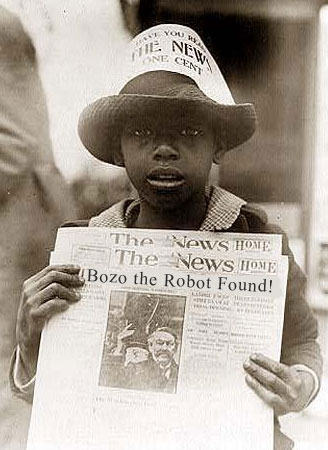
Be that as it may, I believe the reason Robotman is ranked so high here on our survey beating out other Golden Age robots like Bozo, Mr. Atom and Dynamic Man (all personal favorites of mine) is because he appeared in the 50’s in the pages of Detective Comics and then again during the Bronze Age in a few 100 Page Giants.
On top of all that, Golden Age salvage expert Roy Thomas brought the character back in the pages of All-Star Squadron where he served as a team member for many issues.
He was even involved in the first meeting of what would one day become the Justice League of America…

…but this first meeting/mission was suppressed from public knowledge. (Justice League of America 144).
As I mentioned, Roy Thomas makes great use of the character all during his All-Star Squadron run during the 80’s starting with issue 1 (1982) and culminating in a full issue origin story in issue 63 (1985).
At the same time, the current status of Robotman is revealed in DC Comics Presents 31 (1981) in a backup feature Whatever Happened to Robotman? It’s revealed that Robotman has been trapped underground for 20 years, in suspended animation. A sudden boost of energy awakens him into the modern era.

Where he discovers his old lab assistant Chuck Grayson, who was suffering from an incurable brain disease, bequeathed his body to Crane so he could regain his humanity. With his humanity restored, he doesn’t make many more appearances in the modern DC Universe aside from a few cameos in Geoff Johns’ Stars and STRIPE (which was in itself a tip of the hat to the old Star Spangled Comics both heroes used to appear in).
One of the cooler things about Robotman was how often he was getting dismantled or blown apart in his stories, and yet would keep on working. It was nothing to see him separated from his arms or legs and still kicking crime’s ass.

I suppose it's unlikely that we will ever see a modern day revival of the Robert Crane Robotman (as more readers today are familiar with the Doom Patrol character with the same name), but comics (and comics writers) are unpredictable when it comes to nostalgia. There might be a few more Golden Age Robotman stories still to be revealed.
— Jim
1 - Ultron

Yes, Ultron.

Before I do, let me point you to this great recap of Ultron's evolution through the years and to Trey Causey's indispensable short list of the best Ultron stories and where to find them reprinted.
When I was a kid, before there were comics stores in area and a couple of years out from discovering conventions and mail order, back issues may well have not existed. Comics were a rolling target, a perpetual now — the way television used to work. If you missed an issue and weren't lucky enough to have a friend who'd picked it up, you were never going to read it. (That's why Marvel Comics did so much recapping, kids! It's not just that Matt Murdock loves to tell the story of how he was blinded as a child.) In that world, stories published before you started reading a title were a bit exotic. With no internet and few fanzines, you couldn't even read synopses, so you had to glean what you could from footnotes and in-story references. Some things you got the gist of and didn't worry much about. The Hulk had been an Avenger briefly, the FF didn't always wear costumes — that sort of thing. Other things came up frequently enough, in such reverent tones, even a child could tell they were significant. Ultron was one of those things. Like the great blizzard before you were born or when you lived in a different city as a baby. You knew these things happened (in an academic way, at least) and were always fascinated by them, but you never expected them to happen to you in the present day.
 I was nine years old when I read my first Ultron story in Marvel Two-in-One #92 (featuring two other robots who made our countdown!). I'd been reading Marvel Super Action sporadically, absorbing its classic '60s and '70s Avengers tales, but I'd never read an actual Ultron story. I knew Hank Pym had created him, knew he'd picked up an adamantium body along the way, and knew he was a top-tier Avengers baddie who grinned like a murderous jack-o-lantern through his various schemes. I also knew he'd been destroyed. Gone, done, in the past. Not coming back. Because that's how you think comics work when you're nine.
When I saw Ultron staring out at me from the drug-store rack on that Two-in-One cover, I was hypnotized by him, as surely Tony Stark and Jarvis had been. I bought that issue and devoured it one page at a time, not flipping ahead lest I spoil the suspense. Ultron had programmed Jocasta to resurrect him! He was back, and the Avengers had no idea, because it had happened in Marvel Two-in-One! Even the FF didn't know, because, you know, it had happened in Marvel Two-in-One! The only heroes standing in his way at the end of this issue were the Thing, Machine Man, and Jocasta. No Thor! No Iron Man!
As the weeks ticked by, I became increasingly convinced the Thing would die in Marvel Two-in-One #93. My kid-brain couldn't see any way around it. "Well," I thought, "at least I'll be here for the death of one of the Fantastic Four. I won't have to read idly along as Reed Richards recalls that significant event happening 'some months ago' and follow the asterisk down to the footnote. I'll know. I'll have been there." (At 41, I've lived through the deaths of too many of the Fantastic Four.)
Four weeks passed. Or maybe it was five. Either way, I knew it was time for the second part of that Ultron story, and I was determined not to miss it. The church in my small town was having a youth program that week, so I spent the morning in a Bible class, my heart filled with dread and anticipation. I'd looked at the situation from every possible angle, and still I saw no way out for the heroes. My mom picked me up and took me to the local drug store, where the new issue of Two-in-One waited to relieve me of my anxiety. I read it as carefully as I had the first part, taking in Ultron's villainous majesty, reassured that I was indeed reading a real, true, authentic, canonical story of one of the Avengers' greatest foes of yesteryear. (He recalled past plots. With footnotes! You can't get any more legit than that.) When I reached the climax and Machine Man (!) defeated Ultron by reaching into his mouth and yanking out his robotic innards (!!), I was floored. I hadn't seen that coming. His iconic open maw had been his undoing. His defeat had been staring me in the face the whole month — honestly, since before I was born!
 Even at nine, I knew he wouldn't be defeated that way again. I was also starting to get the feeling he'd be back, that I'd get to read more Ultron stories — that he could be recurring for me, just as he had been for those older readers who wrote in to letters pages and occasionally mentioned him. But even if he didn't come back, the way Ultron was defeated satisfied me. It paid off on the visual I'd found so compelling and powerful since I'd first seen him in flashback. What might have been an anticlimax ended up as a resolution.
Let's hope Avengers: Age of Ultron pays off on our collective anticipation, even if that pay-off isn't as bombastic as our imaginations have built it up to be. I'm confident it will, if only because it features Ultron.
— Scott
So there you have 'em — our picks for the greatest robots ever to grace the pages of comic books, stretching from an era when the term robot had barely been invented to the present day, where robots are a fact of everyday life. Did we leave anyone out? Rank anyone too high (or too low)?






 Recently I've been thinking about making a comic specifically for a Mobile Internet Device (MID) or SmartPhone like the the iPod/iPhone,


