
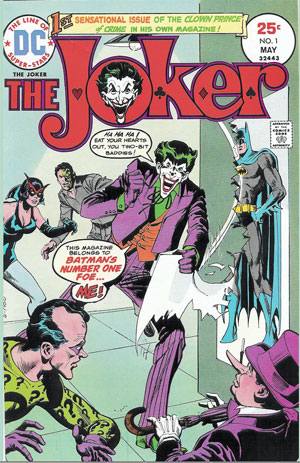
 Editor's Note: Today I am happy to present another Bronze Age Spotlight from Crom who last gave us a great spotlight on Luke Cage. Today Crom has returned and offers us his opinions on The Joker series from the 70's. - Jim
Death of a Clown
So you’ve finished reading your book for the night, your glass of milk is empty. You ease the bindings shut, and place it back on the shelf while reaching over to turn the reading light off -- and that’s when you see the clown standing on your lawn, his painted smile wheezing hot breath, fogging your living room window.
While you entertain this nightmare, it should come as no surprise that The Joker was voted, time and time again, as the highest rated villain in comic history. There are few things that chill the blood as much as the knock knock joke that melts off a face. But the Joker can deliver, so naturally they tried to push him out from under the Bat shaped shadow, into his own circus spotlight.
In 1975, DC commissioned two of its veterans to come up with The Joker’s own book. Julius Schwartz, long time editor in the DC universe, and at the helm of the Batman title since the mid-60’s, got together with Denny O’Neil, a writer that Schwartz himself advocated to DC. O’Neil had already been writing the Batman book for a few years, and had a grip on the characters. It seemed like a bullet proof idea.
The series only managed to pump out nine issues, and the quality being what it was - nine issues too many. The Joker pushed the clown antics of the character to the top, and shrank the vicious acts down to nothing more than a few seemingly random acts of violence. Playing tag with Two-Face, coaching dime-store criminals through their post-thieving crying jags, and general tom-foolery worthy of Benny Hill, the book painted what was a symbol of humanity’s horror’s, into a buffoon who occasionally drops a safe on someone.
O’Neil and Schwartz fell victim to the Clown.
The Clown: is a violent, horrible fellow, but even with grotesque costumes, and exaggerated features, the clown still makes us laugh. The Clown creates a frame through his performance. It lets us consider the sad, wobbling failures of humanity, but at a distance - outside of ourselves. By employing the prat fall, the clown can show us our doubts, fears, and sadness, all through the catharsis of laughter.
The Joker: is a violent, horrible fellow, who laughs alone. The Joker shatters the frame, and perverts the performance so that the failure of humanity is brought close to home by making his audience live it. The tools of the clown; the smiling face, the odd costume, joy buzzers, and balloons are used as a key past our defenses, but with the Joker - it’s to fill us with terror.
The book embraced the former, and forgot the latter. It’s difficult to feel the full power of fear the Joker is capable of when he’s robbing a gum-ball machine, and spraying Onion juice in your eyes, only to detonate an explosive whoopie cushion on a security guard, so that he can steal a box of novelty items, that serve no narrative purpose.
His performance was neutered and made laughable; antics without truth. They forgot why he wears the purple suit, the face like makeup. Why there’s balloons and toys, with happy music. They forgot the most important part of Joker.
There’s nothing funny about that Clown in your window.
Top 10 Most ridiculous Moments in The Joker
 #10 - Joker as Batman... As Joker?
In Issue nine, The Joker's attempt to steal a famous cat actor is foiled by none other than the Catwoman. But when the Catwoman knocks out the Joker, pretending to be a famous actor, he's forced to track down the real deal in order to snatch back the kitty he intended to ransom.
In the midst of his plans, Benny Springer, the movie clown, plays both villains for fools, by dressing up as the Joker himself. Giving us four pages of the Joker battling the Joker.
#9 Rodney Dangerfield providing weapons?
In issue 6, The Joker squares off against Sherlock Holmes; or at least a dazed actor who believes he’s the world’s greatest detective. While fighting on a golf course, The Joker momentarily distracts Holmes by firing a net out of a club-filled golf bag. Very reminiscent of Caddyshack technology.
#8 Overkill
We all know Joker is an irrational being, but in issue 5, he goes from irrational, to downright silly. In his thirst for novelty items, The Joker detonates a warehouse guy an explosion that appears to vaporize half the room. Then makes off with a crate of gag items, worth approximately ten dollars.
#7 Onion juice... seriously?
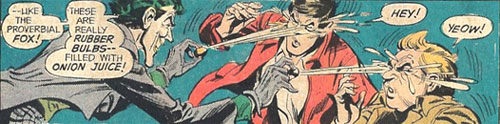
In issue 2, The Joker is pursued throughout by two bungling Arkham guards, who are determined to get their jobs back by capturing the Clown Prince again. When they confront him on the street, he produces two small bulbs, and squeezes them, shooting onion juice into their eyes.
#6 Need a light?
For no apparent reason, The Joker feels compelled to horrible murder a guard, who isn’t guarding anything in issue 5. When the guard asks for a light, The Joker produces a small zippo-type lighter, that sprays a jet of fire into the guards face, who laughs while burning. Ridiculous, and disturbing...
#5 Super Stretch Arms!
As an Arkham guard attempts to bring Joker in, he discovers that the arms he’s attached his cuffs too, are in fact another great punchline. As they snap back, tripping the guard, Joker covers his mouth, with a knockout juice soaked rag...
#4 Bottle Rockets. No, I’m not kidding...
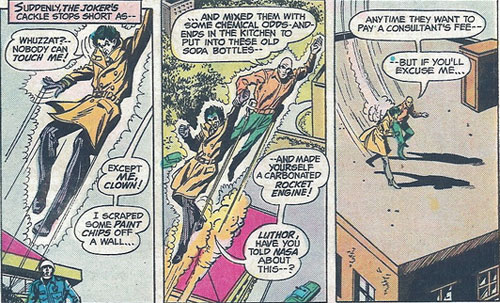
In issue 7, Joker and Lex Luthor are hanging out togther, as they typically do (wha?). Forced to make a daring escape from a road side diner, Luthor fills up several pop bottles with “paint scraped off the walls” and a few other doo-dads, to create pop-bottle jets. He and Joker fly off into another daring escape.
#3 Making off with the Gumballs...
In issue 2, the Joker befriends a fellow thief, with a really emotional problem. Any time Willy The Weeper steals something, he breaks into a fit of tears. The Joker, determined to cure him, takes him out to start stealing on a small scale, in order to dispel his crying. This results in Willy and the Clown Prince of Crime, robbing a gumball machine. That’s right... they steal all the pennies inside.
#2 Mag... Pie?
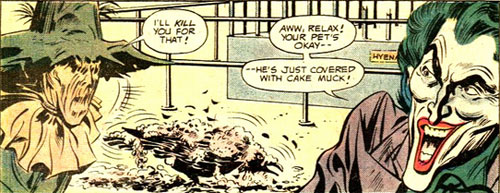
While squaring off against the Scarecrow, The Joker is forced to deal with his annoying Crow, that spreads fear toxin around the area. In order to dispatch it, The Joker hurls an intricately iced cake at the bird, which promptly detonates like ten pounds of dynamite. However, fret not PETA, as in the very next panel, it's revealed that the bird survived the explosion (via editorial mandate no doubt.)
#1 Two Face gets Blinded by Hair
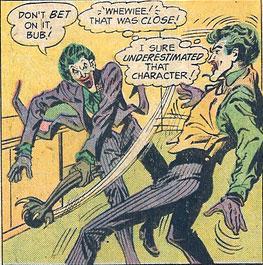
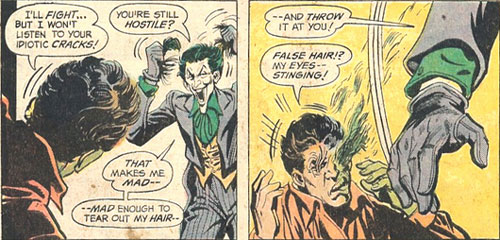
In issue one, the Joker spends much of the issue attempting to foil Two Face's latest scheme because the duel natured dastard refused to free the Joker from prison while escaping. The Joker spends the issue thwarting Two Face at every turn with tried and true Joker gimmicks (creme filled pies laced with acid.) However, the highlight of the issue is when Joker stymies Two Face by throwing his own steel-like hair into Harvey’s eyes.
- Crom


 Editor's Note: Today's Bronze Age Spotlight introduces a new writer to the Flashback Universe Team: Crom! Crom is a fiction and film writer for 2nd Culture, an IP creation company. Crom prefers the rocket launcher to the rail gun, Marvel to DC, and Classical to Post-modern. Crom is not a robot from the future, but we're not sure about his illegitimate offspring. You can learn more at his
 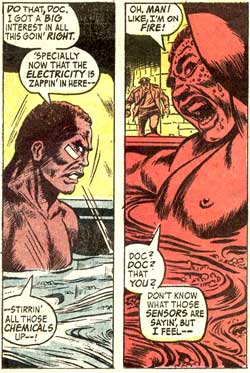 As it does with all comic book Doctors willing to subject human beings to experiments, things turn to the ridiculous... and for Lucas, add 30 CCs more racism.
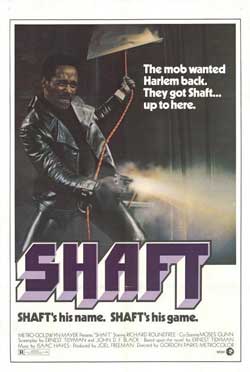 When 1972 hit, the blaxploitation movement was getting a full head of steam. The previous year had yielded two of the biggest films to make the scene: Sweet Sweetback’s Badass Song and the more well known Shaft. The Black badass had arrived. It was an archetype soon placed into mass production.
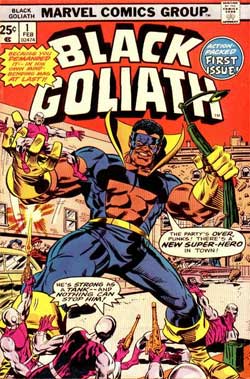 However, let's give Marvel credit for publishing a comic with a black hero as the star and resisting the urge to use the word Black in the title. You KNOW they just wanted to call him Black Power Man. (Which is probably how he ended up with the name of Power Man later on.)