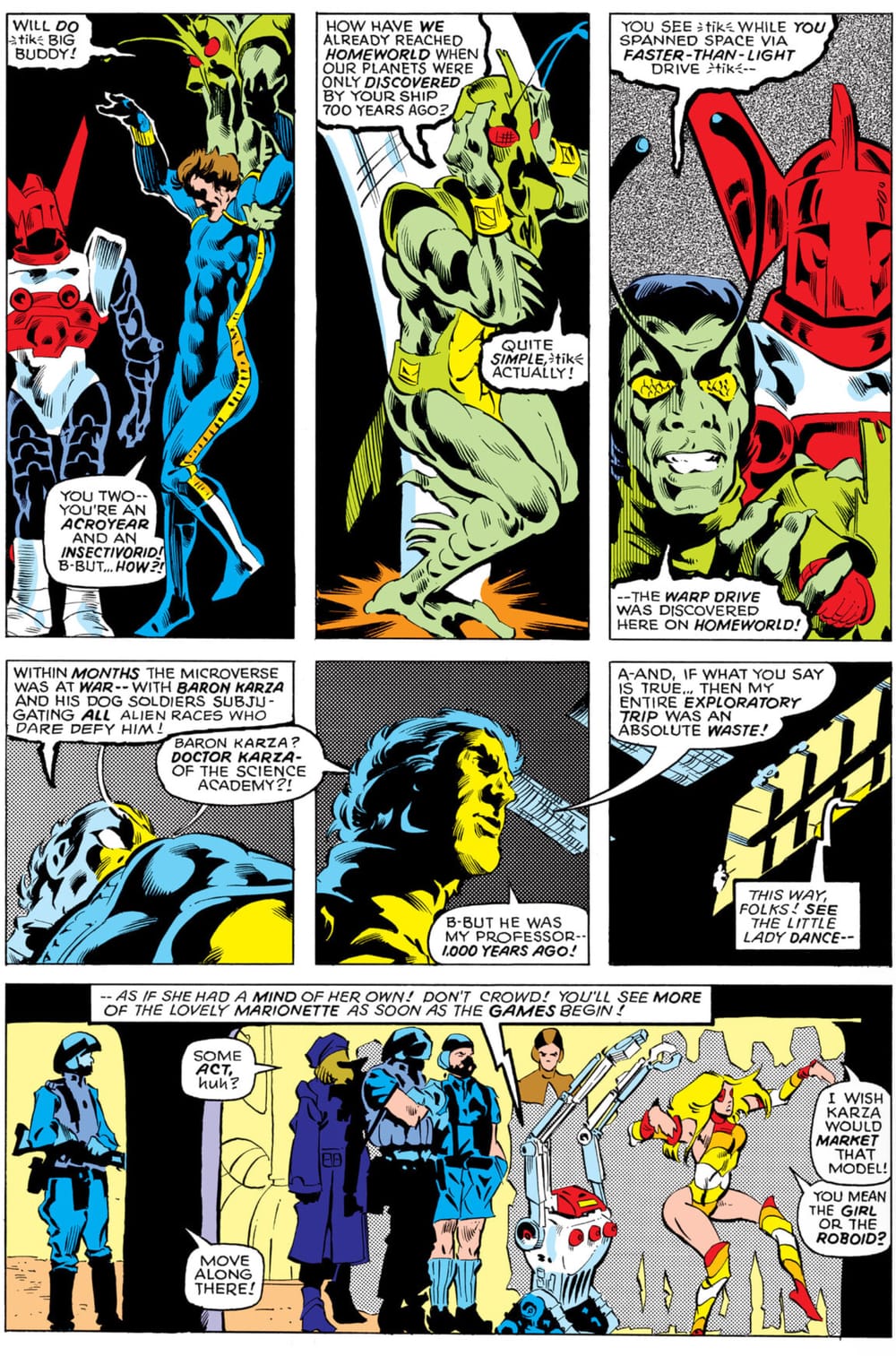
Anticipating receiving the copy of the Micronauts: The Original Marvel Years Omnibus Vol. 2 I preordered soon, I finally got back around to revisiting the contents of the first Micronauts omnibus--stories I haven't re-read in twenty years or more.
I noticed something in those first few issues that I either didn't notice before or had forgotten: the timeline of Baron Karza's rise to power is confusing.
Micronauts #1 (January 1979) by Mantlo and Golden and Rubenstein, opens with the scions of Homeworld's royal family, Prince Argon and Princess Mari being pursued and captured by the forces of the despotic Baron Karza. We are told that the king and queen have been killed, but given their kids are still on the run, every suggestion is that this is a recent event. Karza's coup/revolt appears to be a relatively new thing, though certainly it has been going on long enough he has significant forces at his command and alien allies (the Acroyear) from elsewhere in the Microverse.
Next, we see Arcturus Rann return to Homeworld has his 1000 years long voyage of exploration--and quickly get captured himself. We soon find out that after Rann left on his trip, warp drive was discovered, and the species of the Microverse were connect while he was in flight. "Within six months" of the advent of warp drive (whenever that was) the Microverse was at war thanks to Karza. Rann has heard of Karza. He was his tutor 1000 years ago!
While the information here is unclear, it would suggest at least that Karza's revolt isn't brand new. Perhaps it was centuries after Rann left that warp drive was invented, but whenever it was Karza was in position to launch a war of conquest against other worlds.
Finally, the protagonists of our series are all united in the arena, where Karza and his ally, the Acroyear ruler Shaitan are going to watch their struggles from a position of honor. Shaitan says to Karza:
"It's been almost 24 xats since your insurrection, Karza, and still you enjoy the unswerving loyalty of the rabble!"
We're given no idea how long a xat is, but clearly 24 of them is sufficient time that Shaitan seems surprised the people still support Karza, so I don't think "hours" or "days' would be a good translation.
We also find out Dallah and Sepsis who we've heard people swear by before were Rann's parents. They were deified by the resistance after they were martyred for defying Karza "almost 1000 years ago."
Where does all this leave us?
Almost 1000 years ago, Karza killed the rulers (presumably) of Homeworld Dallah and Sepsis in the Body Banks.
Either that or some other event marks the beginning of his insurrection "24 xats" before the present.
In the present, he has only recently killed the King and Queen of Homeworld (who aren't Dallah and Sepsis), and only at the start of this story manages to capture their children and their entourage.
We're given contradictory clues that Karza somehow both began his coup a long time ago, yet only recently completely it, and we have two royal families with an unclear relationship.
Perhaps there is further information in later stories that would clear this up. Certainly, I can think of a backstory that would make sense of it all, but I do wonder what Mantlo intended?
It's been reported on Mike Grell's website that two volumes of a Mike Grell's The Warlord Omnibus is coming in 2025. What will be in them? Well, certainly First Issue Special #8, Warlord volume 1 issues #1-71 (most of the issues after 52 were either scripted or ghost written by Sharon Grell, but Mike gets sole credit in the issues), Warlord Annual #1, and the 1992 limited series issues #1-6.
The 2006 reboot had nothing to do with Grell's series and is best forgotten. The 16 issues of the 2009 series were written by Grell (and sometimes drawn by him), so hopefully they'll will be in the 2nd omnibus. There's also a guest appearance in Green Arrow (1988) #27-28 by Grell and Jurgens that hopefully gets included.
I wish the full run of the original series was getting collected. Even though the Grell issues are my favorite, I started reading Warlord in the Burkett era/Jurgens era, so I have some nostalgia for that stuff too. Still, if having it relegated to apocrypha is how it must be to get Grell's Travis Morgan saga in omnibus format, then so be it.
There have been a lot of really catchy cartoon theme songs over the decades. Here are ten from American action/adventure cartoons (that call is debatable, but I wanted to exclude strictly comedic ones like The Flintstones, for example) that I think one could make a good case for being among the best. Here they are in chronological order.
Jonny Quest (1964) Trey: This fast-paced, Space Age jazzy number composed by Hoyt Curtin really says action and speaks strongly of the era when it was recorded. According to Curtin in a 1999 interview, the band used for the sessions was a jazz ensemble with four trumpets, six trombones, five woodwind doublers, and a five-man rhythm section including percussion. It stands among the greatest theme songs of all time, period.
Jason: I agree completely, but I must confess I can only regard this banger (and everything before 1985 on this list) through an obscuring mist of nostalgia. Coupled with the attractively Alex Toth-designed highlight reel of explosive violence and weird mystery, this complex, hyper-condensed piece of music captured my tiny heart from the first bongo beats. How could any TV cartoon series live up to the high bar set in this opening sequence? When I saw the show, it was many years in syndication, and the contrast with the then-current Saturday morning fare was profound. Even the theme music was more grown up!
Trey: Like the next one on my list, this catchy tune has escaped from the realm of cartoon themes into pop culture in general, being covered many times and even appearing in-universe in Spider-Man films. It was written by lyricist Paul Francis Webster and composer Bob Harris. The music was recorded at RCA Studios, New Yorks, and the vocals at RCA Studios in Toronto (where the cartoon was produced) featuring 12 CBC vocalists (members of the Billy Van Singers, and Laurie Bower Singers groups).
Jason: Here again, I regard this one as immortal and, in any honest evaluation, rank it among my favorite songs of all time by several entirely subjective criteria. The Ramones version remains my top cover version while the Michael Bublé cover stands unchallenged as my top Michael Bublé song of all time.
Trey: This bubble-gum pop earworm was written by David Mook and Ben Raleigh, and originally performed by Larry Marks. It's probably the most covered theme on this list.
Jason: It's a perfect piece of pop, quintessentially of its era, and ranks up there aesthetically with any "Sugar Sugar" or "Yummy Yummy Yummy" you'd care to name.
Super-Friends (1973)
Trey: Another one from Hoyt Curtin, this is a more of a rousing, martial piece. The producers must have known they struck gold, because they kept it for 13 years, changes to narration aside. It is certainly eminently recognizable. I like this remix for a Cartoon Network promo by Michael Kohler, "The Time is Now."
Jason: A stately call to arms for the forces of good! This type of instrumental-only action show theme song, often characterized by blaring brass sections and delivered with Wagnerian exuberance, practically constitutes a genre unto itself and dates back to the Fleischer Studios Superman shorts from the 1940s.
Trey: In the early 70s, America was in the midst of a "kung fu craze," this show and theme rides that wave. It's short of funky, but also recalls the cliched "Oriental riff" and perhaps borrows a bit of inspiration from Schifrin's theme for Enter the Dragon. Scatman Crothers who voices the main character also sings here.
Jason: That this song is diabolically catchy, I cannot deny. It has stuck with me through long decades during which I neither sought out nor otherwise encountered the source material.
Trey: This theme is a pure slice of the 80s and credited to the duo that dominated the era, Shuki Levy and Haim Saban. Levy's got a page devoted to his theme work, here.
Jason: MASK marks the spot on the timeline after which I will no longer be buoyed by any shred of nostalgia, having ascended to the snottiest and most dismissive epoch in my extended adolescence. I don't recall ever having heard this before, but I am immediately struck by the Flashdance-adjacent aesthetic.
Trey:SilverHawks may be a lazy attempt to iterate another hit from the ThunderCats template (see also TigerSharks), but I think it's got a superior theme song to the original. It was composed by Bernard Hoffer who did a lot of work for Rankin-Bass but was nominated for an Emmy for composing the theme used in the PBS News Hour (originally The MacNeil-Lehrer Report).
Jason: The haunting refrain of the title elevates the pop appeal of this theme, while also delivering the first genuine guitar shredding (or is it synthesizer? Or, heaven forfend, keytar?) yet heard in this listing. This is another first listen for me, and the professional craftsmanship is again evident. It's almost like there's a few surefire formulae in this theme song game.
Trey: This iconic instrumental song with a futuristic (in now a very dated way) vibe was credited (as so many 80s and 90s cartoon theme songs were) to Haim Saban and Shuki Levy, but was written by Ron Wasserman who was under contract to Saban at the time. Wasserman says of the composition and recording in a 2022 interview: "I’d learned to play or emulate any instrument so I would have played every part. Just me, a MIDI keyboard, and a computer."
Jason: So iconic I know it, though I don't think I've watched a full episode of this series. While I am enjoying listening through this listing, maybe I'm starting to develop cartoon theme song fatigue at this point. Do I hear a bit of Miami Vice in this ditty, or have I taken leave of my senses?
Teen Titans (2003)
Trey: This was a well-written series with perhaps a deceptively cartoony look. The great power poppish theme song was written and performed by Japanese pop rock duo, Puffy AmiYumi.
Jason: This one I enjoy without resorting to ironic detachment or nostalgia of any kind. There's more than a small debt to Johnny Rivers' "Secret Agent Man," but it's so dang catchy all is forgiven.
Trey: My daughter loved this show when she was younger, and still revisits it's occasionally. It has a very catchy theme written and performed by Patrick Stump, who Wikipedia tells me is lead vocalist and rhythm guitarist of Fall Out Boy.
Jason: Stump correctly ascertained that a Spidey theme needs to be propulsive enough to communicate the frantic action that will (presumably) follow. It's as good as any post-Fallout Boy emo tune I can currently recall (don't ask how many). Still, good stuff for the kids. Did your daughter enjoy the theme?
Over the summer, I decided to check out the men's adventure paperback series Fargo by John Benteen after discovering it was cheap on Kindle. I became aware of the series thanks to the upcoming graphic novel adaptation, Fargo: Hell on Wheels, by Howard Chaykin.
Amazon bills the series as a Westerns, and I suppose some of them are, in the same way The Professionals (1966) or Fist Full of Dynamite (aka Duck You Sucker) (1972) or other adventure films in Western locales are considered Westerns. They take place in the early 20th Century (1912-1915 in the ones I've read so far) and involve imagery and action out of Westerns (tough men in wild country on horseback with guns), but they involve a range of locales more again to traditional adventure pulp. They range to the jungles of the Philippines and Panama, as well as the more traditional Mexican desert or Yukon.
I've read reviews that refer to Fargo as sort of a "Western Conan." I can see what they mean in that Fargo is tough as hell, irresistible to women (apparently due to sheer manliness, as he is described as unhandsome and hardly has a scintillating personality), and good at most everything in his warrior and outdoorsman purview. However, Benteen's attention to detail regarding gear and preparation for obstacles his hero faces, and his penchant for pitting Fargo against enemies that appear to be a match for him, serve to make the series feel more grounded and realistic. Only slightly pulpy instead of completely so.
Benteen's prose is lean in the mid-Century way, not pulp purple. His action and dialog are punchy and mostly effective but without any lyricism or descriptive vistas despite their natural locales. Unfortunately but predictably given their genre and when they were written, they carry a strong streak of misogyny, some of the volumes more than others. There is also some cultural and racial insensitivity lurking in there too, but in the volumes I have read the narrative is generally sympathetic to both Native Americans and Latinos, though Fargo does exhibit some ill-feeling toward the Moro, who he fought in the Philippines.
They're all quick reads (under 200 pages) and fast-paced. So far I've read:
Fargo (vol 1): Set in 1914 during the Mexican Revolution, Fargo is hired to rescue an engineer (and his mine's haul of silver) from deep inside that war torn and escape bandits with revolutionary pretensions.
Panama Gold (vol 2): A prequel set in 1912. Fargo is asked by Teddy Roosevelt himself to investigate and thwart an attempt to foreign powers to use a mercenary army to sabotage the nearly completed Panama Canal.
Alaska Steel (vol 3) In 1914, Fargo is hired by a movie starlet to find her wayward husband so he can claim his oil money inheritance. The problem is, he has disappeared in the Yukon where he was seeking his fortune as a prospector.
Apache Raiders (vol 4) Fargo is back in Mexico in 1915, smuggling guns for Pancho Villa. He encounters a "lost" tribe of Apaches (a group that never got sent off to Florida) whose leader is planning a general Indian uprising.
Massacre River (vol 5) Perhaps the pulpiest of the stories I have read, Fargo is in the Philippines on a job to escort the daughter of a Chinese businessman to her arranged marriage. If Filipino insurgents weren't enough trouble, there is a family of wealthy, Confederate Lost Cause holdouts, looking to create a new empire and kicking the U.S. out of the islands.
In 2018, TwoMorrows released Comic Book Implosion by Keith Dallas and John Wells, which was an oral history of the DC's 1978 plan for an "Explosion" that ended in failure: The DC Implosion. I talked about the book here.
This year, Dallas and Wells came out with an expanded edition, this one with color. I haven't read it yet, but Amazon tells me it has "additional coverage of lost 1970s DC projects like Ninja the Invisible and an adaptation of “The Wiz,” Jim Starlin’s unaltered cover art for Batman Family #21."
I've been enjoying the latest incarnation of the Flash Gordon comic strip in digital format on the Comics Kingdomwebsite. Cartoonist Dan Schkade relaunched the series on October 22, 2023, and has been doing daily and Sunday installments ever since.
Schkade's series starts right after the defeat of Ming (in Raymond's 1941 strip) and tells the story of what happens as the uneasy alliances of the revolution fall apart and the different kingdoms jockey for power. I think it's a novel approach: something fresher than either a complete reboot we've seen so many times or bland "further adventures" in a world without a strong central conflict.
His design sensibility is strong too. It is broadly "classic," but draws a lot on the 80s film that many readers will be familiar with and adds modern, often light science fictional/space opera touches.
Schkade gave an interview to The Comics Journal regarding his approach here. You can check out the strip on Comics Kingdomhere.
Issue 3 of The Spider magazine (December 1933) is the debut of the writer most associated with the series, Norvell Page, writing under the house name Grant Stockbridge. This wasn't his first sell, but it was definitely his big break in the pulps, though he'll go on to other pulp work including creating the historical Sword & Sorcery character Hurricane John.
If Doc Savage kind of has the sensibility of an 80s action cartoon, Page's Spider novels are perhaps most like the 30s version of the lurid, bloody excess of late 80s-early 90s comics. His debut story, Wings of the Back Death, features New York City being held hostage by a madman threatening to unleash the bubonic plague unless he's paid off. Infectious disease is a big concern in these stories (the first systemic antibiotic had only been introduced in 1932); there's another Spider novel titled "The Cholera King."
Anyway, the first onscreen death of via the plague is a over the top scene where the children of a wealthy woman have been threatened and the Spider has seen that a police cordon is set up around the house. But the wily Black Death infects a cute puppy and sends it into the backyard! The children are playing with it under the eyes of the policeman as Spider runs toward them shouting "shoot the dog! shoot the dog!" He snatches up the little boy and does the puppy-killing himself.
Cut to the little boy dying horribly, spitting up blood, while the doctor and the Spider look on grimly and the kid's mother pounds on the door sobbing because they won't let her in!
Despite that, this one is actually a bit subdued compared to the high body counts and grisly deaths of later Page Spider novels.
In his analysis of the formulae or subgenres of the Mystery genre, Hoppenstand points out that the detective-avenger protagonist tends to pursue conservative ends, and their foes are often demonized anti-status quo forces. Here though, I think an alternative reading is possible. The Black Death is in his civilian identity a banker. He first blackmails not the city but wealthy individuals and all the graphic scenes of people dying of the plague involve the wealthier segments of society. It's true that the Spider's alter ego is a wealthy man, but he spends most of the novel being pursued by the Establishment as the police try to kill him even though he's out to save the city. It's true that in the end, it's revealed that the Black Death works for the advantage of some foreign power, but we are never told which and that's only revealed in one line of dialogue near the end. Wings of the Black Death seems to offer the vicarious thrill of getting to see the wealthy stripped of their privilege and dying of disease, and the spreader of the pestilence is an agent of the financial industry. A very topical foe for the Great Depression!
Page's story really moves. There is a lot of action, though also some movie serial-esque cliffhanger repetitiveness. There is, of course, some pulp clunkiness to the prose--none of the poetry here of a Clark Ashton Smith or even a Robert E. Howard--but I find it superior to say Lester Dent's work on Doc Savage.