Sunday, February 24, 2013

Big Jim's PACK - The Rise of Zorak!

I've often heard comic fans wax nostalgic over the old GI Joe comic book series (probably because it was pretty good and there was a long running cartoon with all the characters) but I've never heard anyone mention the action figure comic that I best remember from my childhood: Big Jim's P.A.C.K!
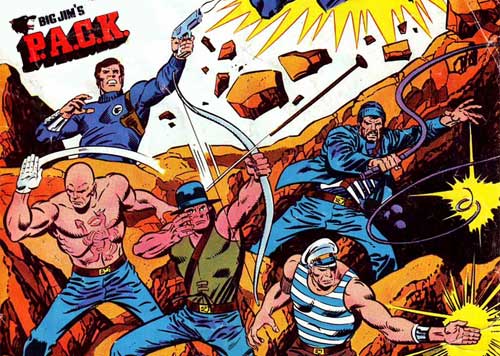
For those of you not familiar with Big Jim, he was Mattel's answer to G.I. Joe. He had a kung fu grip and a button in his back that enabled you to make his arm chop through all sorts of stuff. There are some good sites devoted to the toys, [ big-jim.eu ]

The PACK was Mattel's second attempt to give the Big Jim toyline a profit making entourage, the first one appearing in 1972 was a rather generic ensemble of teammates all copying the Big name theme(Big Jeff, Big Josh, Big Jack.)

The first line up must've been a bit of a failure (or perhaps the similar sounding names just proved confusing to toy hunting parents) as Mattel quickly produced a revised team featuring much more colorful characters in 1976 with box artwork provided by Jack Kirby.
Marvel was also contracted to produce an introductory comic book of all the characters which was superbly drawn by John Buscema.

In issue one we are first introduced to each of of the PACK team members (and I'll get to what PACK stands for in a second...)

First up is: Dr. Steel
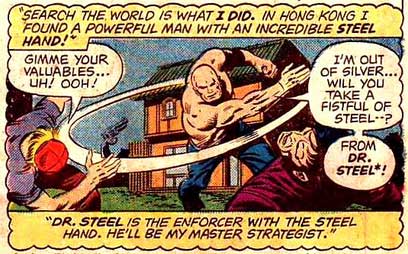
I guess he's a Doctor in Running Around With Your Shirt Offology.

Next up: The Whip
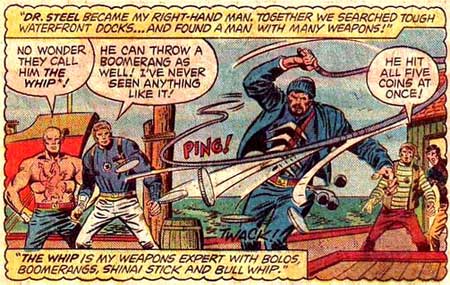
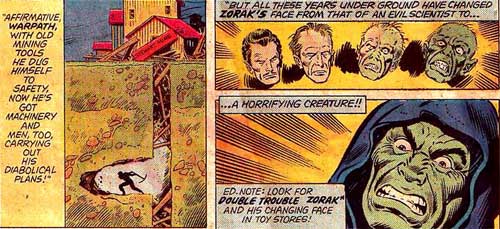
The hunter/tracker of the group is Warpath.
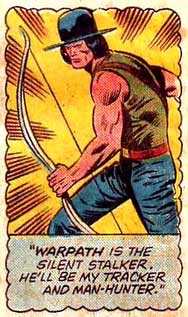
(Dig the cool Billy Jack Hat!)

The group is completed with the presence of the bionically armed Torpedo.
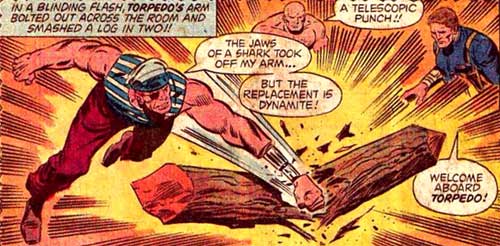
With this rugged team of adventures assembled, Big Jim christens them The PACK which stands for Professional Agents/Crime Killers.
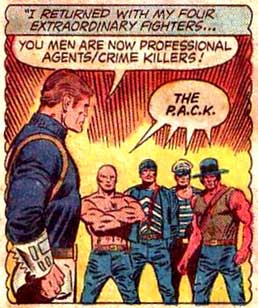
I'm not really certain how to parse Crime Killers, but it doesn't sound like this group is going to be reading a lot of Miranda Rights during their exploits.

Each member is given a hand tattoo and stamped shoes for easy tracking.
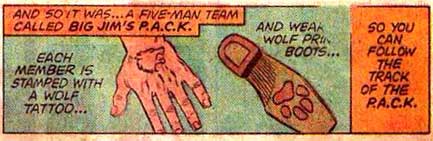
That probably makes working in the shadowy world of international espionage a bit challenging, but HR believes it encourages team building, so what are you going to do?

Once assembled, the government contacts the PACK to bring down a dangerous adversary: Zorak. No relation to GI Joe's Zartan, though the names do seem similar. (Fun fact: Zartan was an anagram of Tarzan created by comics writer Larry Hama.) Nor is he any relation to the same named character from Space Ghost, though they are both green.
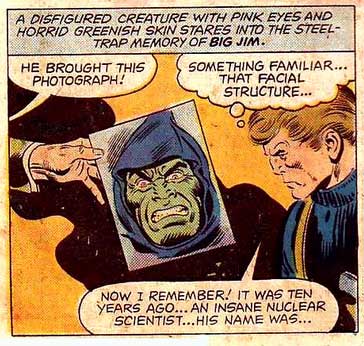
Zorak's origin is recapped in three panels:
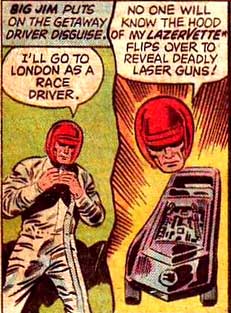
To handle this assignment, the PACK are all given cool weapons and outfits from the government; like Big Jim who gets a awesome car.
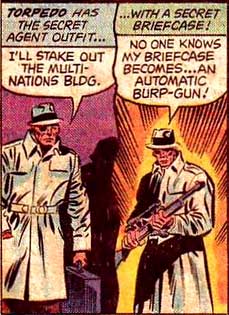
Or The Torpedo gets Secret Agent gear.
So I bet you are expecting Warpath will get some sort of cool exploding arrows or zip line and cross bow set up, right? Think again.
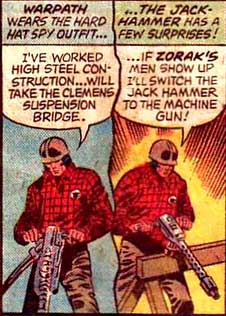
I appreciate that they tried to give Warpath a bit of backstory by saying he's worked construction before, but they probably could've taken another run at this idea before stamping it Ready To Go.

Anyway, as the mission continues, each member of the PACK gets a chance to demonstrate that they are as smart as they are bold.
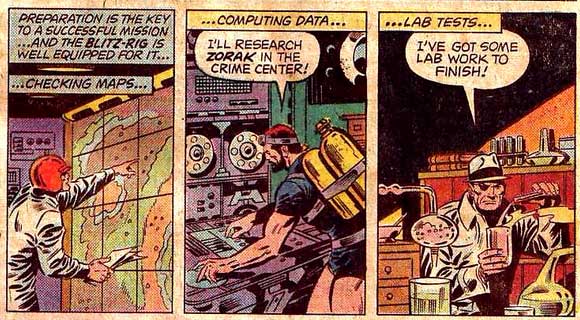
Again, Warpath gets shafted. (see what I did there?)
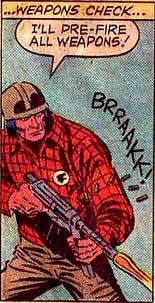
So everyone is geared up and proceeds with the mission. The first to encounter the forces of Zorak is Big Jim.
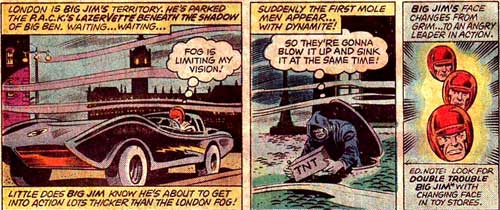
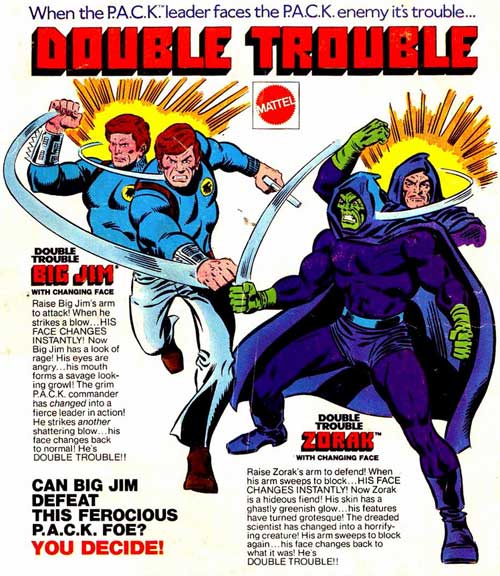
Now, maybe this is just me, but if your Team Leader is limited to two expressions: Grim and Angry, then you sort of have to question his planning ability, don't you? Shouldn't Happy, Satisfied or at least Surprisingly Relieved be options? I mean how would you feel if at the end of a successful mission the best face your boss rewarded you with was Grim? You'd sort of wonder what the heck he wasn't telling you.

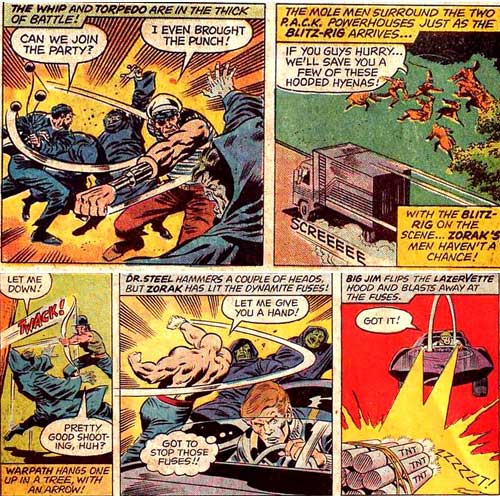
After some covert reconaissance by each team member, Zorak's master plan is revealed and the team springs into action and takes his operatives down in true Big Jim fashion.
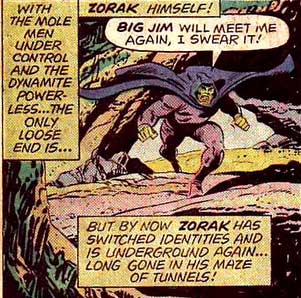
Unfortunately, Zorak gets away:
Thus giving Big Jim a good opportunity to use one of the only two expressions he can muster at the end of a mission.
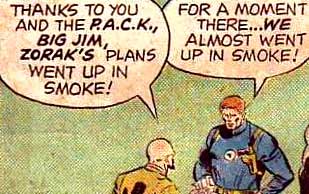
One of the other PACK members might want to privately speake to Big Jim about how you sell success. Telling mission command you almost lost the whole team isn't the sort of thing that looks good on your year end performance review.

Well, maybe Big Jim will learn a lesson from this adventure about the dangers of blindly jumping onto an assignment without proper examination of the mission parameters and objectives...
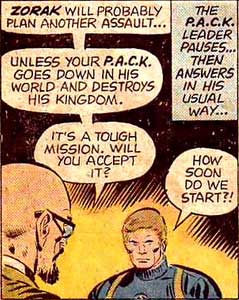
...or not.

I see another grim faced mission conclusion on the horizon.

Hope they rest of you have a week that's Big!

- Jim

Monday, February 18, 2013

Meaningful Superhero Comics

Over on his facebook page, David Gallaher asked this question which resulted in quite a number of interesting responses:

What mainstream _superhero_ comic in the last 25 years was really meaningful to you? We're talking stuff published AFTER 1988. Why?

After some thinking, I finally arrived at James Robinson's And Tony Harris' Starman

Robinson found a way to really give Jack Knight's character a unique voice in what was becoming a very generic superhero universe. Jack's dilimenas were less about how would he defeat the villain of the day, but rather how would he resolve long standing family issues. If that sounds boring, it's because that is only a small facet of the incredible story that Robinson wove in Starman. Other elements were great homages to Golden Age heroes, dramatic action with reinvented villains and somber interludes with Jack's dead brother. This is one of those titles that deserves the praise people have been piling on it over the decades.

My backup choice is a bit of an oddball. It's Garth Ennis and John McCrea's Hitman

I'm certain that many readers will look askance at such at choice as this book probably is most widely known for its grand guignol style and farcical portrayal of the rest of the DC universe, but you read the series, Ennis takes his time in revealing the rather poignant story of Hitman Tommy Monaghan. In some ways, it feels like the grim old Irish Ballads that are sung in the bar Tommy calls home.

I asked another longtime comics fan this question and he came up with two entirely different answers. His first choice was Grant Morrison and Frank Quitely's All-Star Superman.

I must admit that I've only seen the movie of this series and have never read the comics. (I think I read the first issue, but due to either the irregular publishing schedule or my own apathy, I gave up on the series.) However, just googling covers for this article was enough to make me want to go and read everything from beginnging again. (I think I have a better handle of what Morrison was trying to do here now too.)

The second choice picked was another that I left after a few issues. Alan Moore's and Chris Spouse's Tom Strong.

I remember enjoying the issues I read, but never enough to follow it devotedly (albeit, that's a problem I have with a lot of series.)

As I was thinking of my answers for Gallaher's question, I found myself remembering the FIRST superhero comic I found meaningful. Jim Starlin's Warlock.

Starlin's run on Warlock opened my eyes to what was possible in superhero comic stories. Pathos, satire and allegory - all in one exquisitely drawn space opera. Because of the level of storytelling going on here, this is one of those few Bronze Age classics that holds up well even in this day and age.

I'm going to end today's post with a question:

What Superhero comics have you found meaningful?
- Jim

Monday, February 11, 2013

Can Superman Save the Justice League Movie?

It's been a tough couple weeks for the Justice League movie:
At this point, the Man Of Steel is going to have to hit pretty big to keep the project going. Which got me thinking: Exactly what is the dollar target MoS needs to hit to be successful?
Doing a bit of research, I found out some interesting things (to me) about how movie companies and movie theaters split their revenue.

I had always heard it was based on a sort of sliding scale with the companies getting the lions share the first week and then getting less as each week progressed. Apparently, that has changed some - now movie companies negotiate a standard cut with the theater regardless of which week it is. Now theaters can get between 45% to 60% of the box office every week.


From an article on i09:

You can actually look at the securities filings for the big theater chains, to look at how much of their ticket revenues go back to the studios, points out Stone. So for example, the latest quarterly filing by Cinemark Holdings, shows that 54.5 percent of its ticket revenues went to the distributors. So as a ballpark figure, studios generally take in around 50-55 percent of U.S. box office money.

Also, apparently foreign box office is NOT very lucrative because the splits there are even worse.

According to the book The Hollywood Economist by Edward Jay Epstein, studios take in about 40 percent of the revenue from overseas release — and after expenses, they're lucky if they take in 15 percent of that number.

The article also says that while DVD sales used to be something studios could count on to help a movie break even, that has become less true starting in 2009 as DVD revenue has gotten weaker. The article suggests Netflix might be the reason for this - which would explain why Time Warner hates Netflix so much.

Taking all that in consideration, with a production budget of 225 million, lets say (using worse case percentages from above) Man of Steel will need $250 million domestic and $250 million global to be counted as a money maker.


Also, I think Man of Steel will need to make a good bit more than Superman Returns million in its first weekend ($55 million) to be counted as a success by Warner Bros. For comparison, Captain America had a production budget of $140 million and made $65 million in the opening weekend. (A target number I correctly predicted)

Man of Steel has a budget of $200 million, so I would suspect anything less than $80 million would be seen as a opening weekend failure.

With all that said, I think that the movie can make its money back overtime, but will be a opening weekend failure. I predict $75 million for the first weekend.

With all that said, I wouldn't hold my breath for the Justice League movie.

- Jim

Sunday, February 3, 2013

The Lost Green Lantern 100 Page Spectacular

Today I continue my series of Lost 100 Page Super Spectaculars with this entry featuring a Green Lantern themed issue:


The Green Lantern vs Wildfire illustration comes from the very talented Adam Moore who is known as Laemeur on deviantArt.com. You can see more of his artwork on his website:  http://laemeur.com/

Adam actually sent me two versions of the illustration above. The second one was one where he had used some photoshop filters to give the artwork a cool retro effect. You can see it below. (Click to enlarge for more detail)

 Not sure if you guys are really digging these Lost 100 Pagers or not (they don't seem to elicit many comments) but I'm digging creating them. With this one, I took the liberty to mock up the Jimmy Olsen image to create neat little Green Lantern themed Olsen story.

In looking up covers to use for this 100 Pager, I was struck by the fact that Green Lantern never got his own 100 Page Super Spectacular. About as close as he got was the 52 pager. below.


 As far as I can tell, Green Lantern seems to have been in a bit on the backburner during this time period. It was before Mike Grell started his Green Lantern/Green Arrow series and some time after Jordan's Silver Age heyday.

Outside of the recent Geoff John's era of Green Lantern, he's never been a huge pull on a title. Wonder Woman and The Flash actually have a longer unbroken run than GL. (And I would suspect more name recognition among the general populace due to television shows based off the characters.) This raises the question: Why did Warner Bros decide to spend 200 million dollars making a Green Lantern movie? Why GL and not Wonder Woman or The Flash?

The lack of wider name brand recognition might have been a huge factor in the dismal Green Lantern movie opening weekend.

- Jim


Monday, January 28, 2013

Comic Series I Stayed With Too Long

I think a common complaint from long time comic readers is that at some point in time, they find themselves buying a comic series that they no longer enjoy. I hear this sentiment echoed on podcasts presently, and it has been true for me at several points in my history with comics. Here are a couple of examples of comic runs I continued with, but really should have dropped.

First up - from the Bronze Age: Marvel's Werewolf By Night

What happened was I was a huge fan of the Mike Ploog era of this series. I also have a soft spot for horror/adventure stories that feature characters that don't fall in the standard mold. So, initially, I found a lot to like with WBN. Ploog's stylistic storytelling approach was just a huge bonus.


Unfortunately, after Ploog left, I think the series started to stray from its creepy core. By the time Moon Knight showed up, I was pretty bored with the series and was just buying it out of habit.


But I hung in till the bitter end...


Looking back, I can excuse this by remembering that I was more of a completist when I was younger. Also, most Marvel and DC were less inclined to shift from their thematic axis as WBN had. Marvel Team Up at issue 98 was pretty much the same as any other Marvel Team Up prior to it. The gradual tone shift in stories sort of snuck up on me.

I took a break from most mainstream comics around this time, delving into more of the independent publishers that were cropping up (Comico, First and Dark Horse being the main ones I was reading at this time.) The one mainstream DC series I managed to follow during this time period was the Giffen/Levitz Legion of Superheroes. I dropped off a bit around the Late 80's (it was probably the continuity mess caused by Crisis on Infinite Earths which caused me to lose interest in the series.) However, when I heard about the premise of the 5 Years Later story line I jumped back in the game. It was just the thing for a lapsed DC fan like me.


Those first few years of the 5YL stories were amazing. I didn't always understand some of the references or know who the characters were, but my experience with the more mature stories in Independent comics had taught me not to worry about such things.

Alas, after a few years of stories where you reveal just how much everything has changed, you sort of run out of stuff to show changed, and end up with generic superhero stories. And the solution to this problem (introducing the SW6 batch of LSH Silver Age duplicates) was not way to solve the problem, imo.

Still, I hung in there with this series, buying all the issues right up until they decided to reboot the Legion with Zero Hour. After the Zero Hour reboot, the Legion has never really regained its prominence in the comics market. At one time, LSH was a huge seller, but countless attempts to reboot it back into relevance have just resulted in skeptical old school fans like myself and apathetic younger fans who are intimidated by the history of the series.

Finally, the most recent series I just couldn't stop buying was the 2000's era JLA. Like most comic fandom, I loved the Grant Morrison and Howard Porter's run on the book:


...but the series quickly lost steam after Morrison left (despite a few good stories by other writers.) I think the problem here was, Morrison was telling huge, fantastic stories that the JLA happened to appear in. Other writers tried to tell big stories with the JLA. They sort of begin the project with a handicap off the bat so to speak. I remember barely being able to get through some of the later storylines (Busiek's Crime Syndicate storyline being a real chore for me iirc.) By the time Byrne and Clairemont had a shot on the series, I was well and done. I remember liking their arc on principle but not on merit.


So, what about you? Have there been any series you just kept buying long after you stopped enjoying them?

- Jim

Monday, January 21, 2013

Paul Kirk Manhunter 100 Page Super Spectacular

Continuing my series of Lost 100 Pager Super Spectaculars from the 70's, I present this edition featuring the Archie Goodwin, Walt Simonson version of Paul Kirk, Manhunter.


The main artwork was created by the incredibly talented Jan "Reno" Maniquis, a name some regular visitors may recognize as Reno is a longstanding commenter on the FBU. In order to get the illustration to fit in my 100 Pager format, I had to crop it in such a way that some of the cool details Reno provided are missing, so below, I present the uncropped version for everyone to enjoy. (Click to enlarge)


 You can check out more of Reno's art at his website: http://capsulezone.wordpress.com/

As we were working on this art, Reno picked the Irv Novick version of Talia's costume to use for this illustration - a costume I only vaguely remembered. I tend to think of Talia as always dressed as she was on the cover of Detective 444 (another 100 Pager). I think Reno's choice was the better selection as purple costume has a more Eastern flair.


As to why I chose Paul Kirk, Manhunter for a 100 pager - I must admit to wanting to read more of his adventures. I've talked about my love for that series before, but it's far better that he remain dead. I don't think the current editorial climate at DC is quite the right place for a comic like the old Archie Goodwin, Walt Simonson Manhunter.

On the flipside, I will say that Dynamite's current The Shadow series has done a good job of capturing some of the old Bronze Age Manhunter feel. While the artwork is not as exciting as Simonson's, the exotic locales and intrigue often remind of what I enjoyed so much in the old Manhunter stories.


Feel free to post a suggestion for another Lost 100 Pager in the comments section!

- Jim

Sunday, January 13, 2013

I Can Prove It With Charts!

Last week Diamond released their list of the Top 500 Graphic novels sold in 2012 which resulted in a lot of commentary about what a bad job Marvel is doing in the book market (considering how successful their movies are.)

While several commentators had good analysis on the numbers, I felt the data could have been sliced up a bit better in some cases, so today, I've got charts galore doing just that.

First up - DC Trade sales vs Marvel Trade Sales


As you can see, DC leads the way pretty much 2 to 1 ahead of Marvel in the Graphic Novel market.

Now, is that all Watchmen and Kingdom Come trades flying off the shelves you ask? Well this next chart shows the breakdown between old stuff and new content.

For DC, Reprinted material is a clear winner. Not so much for Marvel. I think that can be attributed to two things. One, DC does a much better job keeping their old stuff available for reprinting. Marvel tends to let books go out of print at the drop of a hat. Also, DC has a broader base of material to reprint (Covering Golden Age to Vertigo)

Which begs the question: How important is Vertigo in the scheme of things? I've always been one of those people who sort of felt Vertigo lost its relevance when Sandman stopped coming out on a regular basis. Looks like I was pretty well wrong.


As it turns out - Vertigo Graphic Novels make up over 12% of all Graphic Novel sales at DC. That's a good bit higher than I would have thought.

Still, it's easy to see that Superhero Graphic Novels are the bread and butter, so which of those are selling the best? The answer might surprise you:


Looking at this chart, I'm struck at the huge disparity between Superman and Batman! Now some people might say that can be due in part to Batman having had several successful movies in the last decade. However, why isn't the same true for The Avengers?

I'm also impressed to see the X-men brand remaining so vital in the Graphic Novel market as it languished in the comic market (until the recent Marvel Now revamp.) What is also interesting is just how close the smaller guys all are. The X-men are the only other group with a two digit percentage point and even they aren't out of the teens.

Finally, in comic shops, the dominant sales strategy is Events. But how does that play out in the trades? Not too good it would appear!


This was another one that sort of surprised me, as I think I would have said Event trades probably sold as well as non-event trades, but that's clearly not the case. Apparently the trade market is much less enamored with events than the Wednesday Comic Shop crowds.

Looking at all this, I can't help but think that 2013 will bring some big shakeup in the Marvel Trades publishing side.

- Jim

LinkWithin

Related Posts with Thumbnails